Dinoustech Private Limited
Panchang App Development: How to Build a Panchang, Muhurat and Hindu Calendar App
Panchang app development means building a mobile or web app that shows the daily Hindu calendar for the user's location: tithi, nakshatra, yoga, karana, sunrise and sunset, auspicious and inauspicious timings such as Rahu Kaal and Abhijit Muhurat, festivals and vrat dates. Good Panchang apps add muhurat search, personal reminders, choghadiya, kundli tools and live astrologer consultations on top. This guide explains how a Panchang app works, the features users expect, the calculation engine, AI features, the build process, tech stack, monetization, cost factors and timelines, for founders, astrology platforms, temples and spiritual brands serving users in India and the global Indian diaspora.
Key Takeaways
- A Panchang app is a location-aware astronomy and calendar engine wrapped in a simple daily experience. Accuracy and correct time zones matter more than anything else.
- Core features are daily Panchang, muhurat timings, choghadiya and hora, a festival and vrat calendar, and smart reminders.
- You can calculate Panchang data with an astronomy library on your own server or use a Panchang API. Both need careful testing against trusted references.
- Diaspora users in the USA, UK, Canada, UAE and Australia need results for their own city, not Indian time.
- Revenue usually comes from premium muhurat tools, ad-free plans, reports, puja bookings and paid astrologer consultations.
- Cost depends on the calculation approach, number of languages, regional calendar styles, platforms and add-ons such as live chat and video consultations.
Table of Contents
- What Is a Panchang App?
- Why Build a Panchang App Now
- How a Panchang App Works
- Types of Panchang Apps
- Key Features
- The Calculation Engine: Build or Use an API
- Step-by-Step Development Process
- Recommended Tech Stack
- How Dinoustech Uses AI
- Monetization Models
- Privacy and Content Responsibility
- Cost Factors
- Development Timeline
- Challenges and Solutions
- Why Choose Dinoustech
What Is a Panchang App?
Panchang (also written Panchangam) is the traditional Hindu almanac. It describes each day through five elements: tithi (lunar day), vara (weekday), nakshatra (lunar mansion), yoga and karana. Families use it to plan pujas, fasts, festivals, weddings, griha pravesh, vehicle purchases and other important events at an auspicious time.
A Panchang app turns this almanac into a daily companion. It calculates every value for the user's exact location and time zone, explains it in simple language, and reminds users before important timings and festivals. Many apps also connect users with astrologers and pandits, which turns a free daily habit into a business.
Why Build a Panchang App Now
- Daily habit: users open a Panchang app every morning to check tithi, Rahu Kaal and the day's muhurat, which gives strong retention for an astrology or spiritual brand.
- Global audience: millions of Indian-origin families live abroad and need festival dates and timings for their own city, which printed calendars cannot give.
- Entry point to paid services: a free Panchang brings users into kundli reports, matchmaking, puja booking and paid consultations. See how astrology apps make money.
- Content and SEO: daily Panchang and festival pages can also drive search traffic to the website version of the product.
How a Panchang App Works
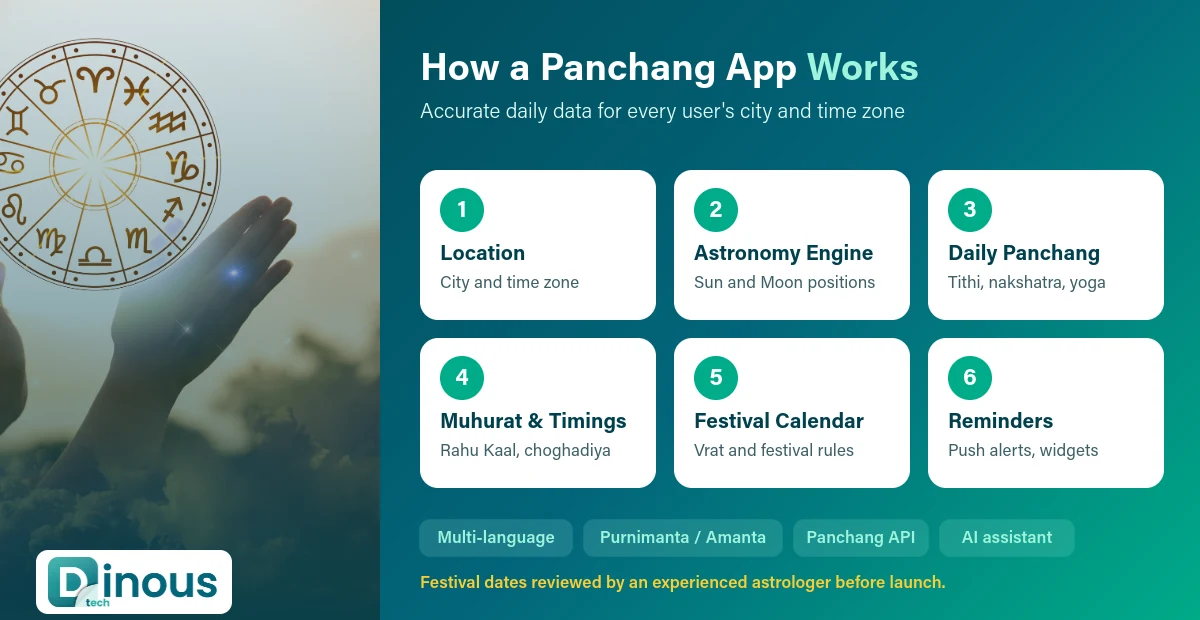
- Location: the app gets the user's city or GPS position and the correct time zone, including daylight saving time abroad.
- Astronomy engine: it calculates the positions of the Sun and Moon, sunrise and sunset for that place and date.
- Panchang elements: from these positions it derives tithi, nakshatra, yoga and karana with exact start and end times.
- Muhurat and timings: it computes Rahu Kaal, Yamaganda, Gulika, Abhijit Muhurat, Brahma Muhurat, choghadiya and hora.
- Calendar rules: it applies the chosen calendar system (for example Purnimanta or Amanta months) to mark Ekadashi, Purnima, Amavasya, Sankranti, festivals and vrat dates.
- Delivery: results appear on the home screen, widgets and notifications, in the user's language.
Types of Panchang Apps
- Daily Panchang and calendar apps: tithi, timings, festivals and reminders, usually free with ads or a premium plan.
- Regional calendar apps: focused on Telugu, Tamil, Kannada, Malayalam, Bengali, Gujarati, Marathi or Odia calendar styles and languages.
- Muhurat finder apps: search the best dates and times for marriage, griha pravesh, naming, vehicle purchase or business opening.
- Full astrology super apps: Panchang plus kundli, horoscope, matchmaking and live consultations, like the platforms described in our AstroTalk-style app guide.
- Temple and community apps: Panchang plus event calendars, puja booking and donations for temples and community organisations abroad.
Key Features of a Panchang App
User features
- Daily Panchang: tithi, vara, nakshatra, yoga, karana, with start and end times.
- Sunrise, sunset, moonrise, moonset and moon phase.
- Auspicious and inauspicious timings: Abhijit Muhurat, Brahma Muhurat, Rahu Kaal, Yamaganda, Gulika.
- Choghadiya and hora tables for day and night.
- Monthly calendar with festivals, Ekadashi, Purnima, Amavasya, Sankranti and vrat dates.
- Muhurat finder for chosen activities and date ranges.
- Personal reminders for fasts, festivals and family tithi dates such as shraddha.
- Multi-language support and regional calendar styles.
- Home-screen widgets and morning notifications.
- Optional add-ons: kundli generation, daily horoscope, matchmaking, astrologer chat and call. See must-have astrology app features.
Admin features
- Festival and vrat rules management, by region and calendar type.
- Content management for festival stories, puja vidhi and articles in each language.
- Notification scheduling and audience segments by city and language.
- Subscription, payment and refund management.
- Astrologer onboarding, availability and payouts if consultations are offered.
- Analytics for daily active users, retention and premium conversion.
The Calculation Engine: Build or Use an API
The engine is the heart of the product. There are two main approaches:
| Approach | How it works | Best for |
|---|---|---|
| Own engine | An astronomy library (for example one based on Swiss Ephemeris or an open-source Panchang library) runs on your server, with your own rules for tithi, muhurat and festivals. | Brands that want full control, regional calendar variations, offline caching and no per-call fees. Check each library's licence before commercial use. |
| Panchang API | A third-party API returns Panchang, choghadiya and hora for a date, time and location. | Faster MVPs, with a monthly API cost and dependence on the provider's accuracy and uptime. |
| Hybrid | Start with an API, then move core calculations in-house as usage grows. | Startups that want to launch quickly and reduce costs later. |
Whichever approach you choose, test results against trusted printed Panchangs and well-known references for many cities, dates and edge cases such as kshaya and adhika tithis, adhik maas, polar-latitude sunrises and daylight saving changes.
Step-by-Step Panchang App Development Process
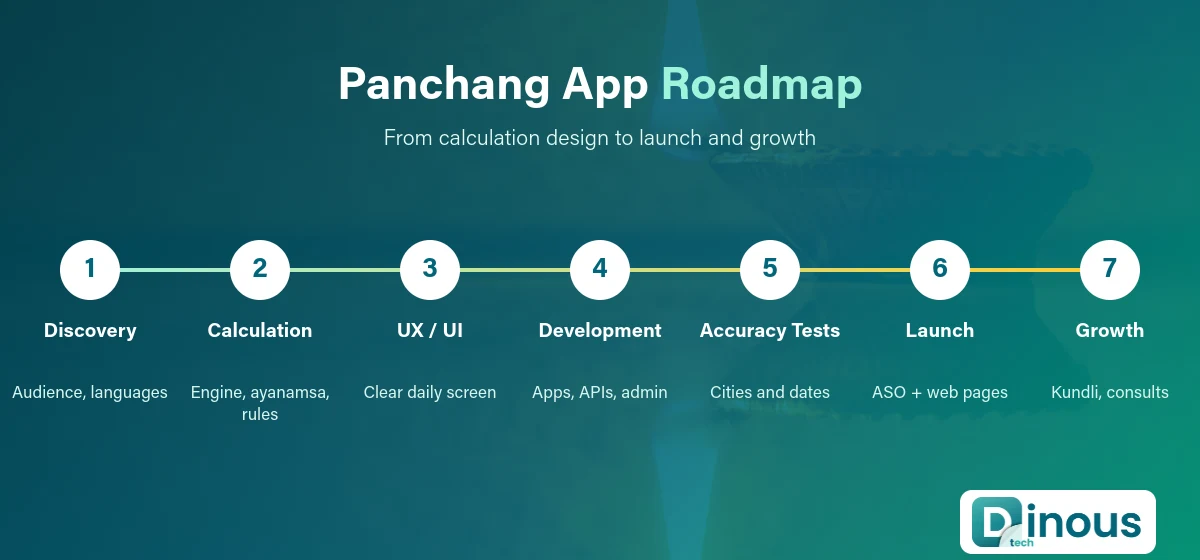
- Discovery: define the audience (India, diaspora or both), calendar styles, languages, and which add-ons to include.
- Calculation design: choose the engine approach, ayanamsa and calendar rules with an experienced astrologer as advisor.
- UX and UI design: a clean daily screen that is easy for older users, with large text and clear timings.
- Development: engine and APIs, mobile apps, admin panel, notifications and payments.
- Accuracy testing: compare results across hundreds of city and date combinations, and have an astrologer review festival dates.
- Launch: app store optimisation in each language, plus website Panchang pages for search traffic.
- Growth: add muhurat finder, kundli, consultations and puja booking based on user demand.
Recommended Tech Stack
| Layer | Options |
|---|---|
| Mobile apps | Flutter or React Native for Android and iOS, with native widgets |
| Web | Next.js or React for SEO-friendly daily Panchang and festival pages |
| Backend | Node.js, Python or Java, with REST or GraphQL APIs |
| Calculation engine | Astronomy library or Panchang API, with result caching per city and date |
| Database | PostgreSQL or MongoDB, plus Redis for cached daily data |
| Location and time zones | Geocoding service and IANA time zone database |
| Notifications | Firebase Cloud Messaging and Apple Push Notification service |
| Payments | Stripe, Razorpay, Apple and Google in-app purchases |
| Consultations (optional) | Chat, voice and video SDKs with call billing |
| Cloud | AWS, Google Cloud or Azure |
How Dinoustech Uses AI in Panchang and Astrology Projects
- AI-assisted development: our developers use AI coding tools to write tests, generate edge-case test data for many cities and dates, and review code, which speeds up delivery while engineers keep control of the logic.
- AI features in the app: an AI assistant that explains today's tithi or a muhurat in simple words, answers questions such as "Is today good for buying a car?", translates content into regional languages and personalises reminders. These features should explain the traditional rules, not invent new ones, and point users to a human astrologer for personal guidance. Learn more in AI in astrology and our AI astrology app cost guide.
- AI support for clients: we can add an AI support agent that answers common user questions about subscriptions, timings and app settings, and hands complex issues to your team.
Monetization Models
- Freemium: free daily Panchang, with a premium plan for the muhurat finder, detailed timings and an ad-free experience.
- Ads: carefully placed ads for free users.
- Reports: paid kundli, annual predictions and muhurat reports.
- Consultations: per-minute chat and call with astrologers, with a revenue share.
- Puja and services: online puja booking, temple services and spiritual products.
- B2B licensing: Panchang widgets or APIs for temples, media sites and other apps.
Privacy and Content Responsibility
Panchang apps use location and sometimes birth details, so ask for consent, collect only what you need and follow privacy laws such as GDPR, India's DPDP Act and app store rules. Present astrological content as traditional guidance, avoid health or financial promises, and clearly label AI-generated explanations. If you take payments or offer paid consultations, show clear pricing and refund terms. This is general information, not legal advice.
Panchang App Development Cost Factors
There is no single price for a Panchang app. The budget depends on these factors:
- Calculation approach: a Panchang API is faster to start with; your own engine costs more upfront but avoids per-call fees.
- Calendar coverage: each regional calendar style and festival rule set adds design, development and testing work.
- Languages: every language needs translated content, festival text and testing.
- Platforms: Android, iOS, web, widgets and smartwatch apps.
- Add-ons: kundli, matchmaking, horoscope, live chat and calls, puja booking and e-commerce.
- AI features: assistants, translation and personalisation, plus model usage costs.
- Design quality and accessibility for older users.
- Post-launch support: yearly festival rule updates, OS updates and server costs.
For a wider view of astrology budgets, read our guides on horoscope app development and building an app like AstroSage, or get a quick estimate with our app cost calculator.
Development Timeline
| Scope | What is included | Typical timeline |
|---|---|---|
| MVP | Daily Panchang, timings, festival calendar, reminders, one or two languages, Android and iOS | 8-12 weeks |
| Full Panchang app | Muhurat finder, choghadiya and hora, widgets, several languages and regional calendars, subscriptions | 3-5 months |
| Astrology super app | Panchang plus kundli, matchmaking, live consultations, puja booking and AI assistant | 5-8 months or more |
Timelines depend on scope, content readiness and how quickly calculation results are verified.
Challenges and Solutions
- Accuracy disputes: different traditions use different rules. Let users choose their calendar style and show which method is used.
- Time zones abroad: use exact coordinates and the IANA time zone database, and test daylight saving changes.
- Festival date differences: festivals can fall on different dates by region. Keep festival rules editable in the admin panel and review them with an astrologer every year.
- Retention: make the morning notification genuinely useful, add widgets and keep the daily screen fast.
- Older users: use large text, simple navigation and voice explanations.
Why Choose Dinoustech for Panchang App Development
- Dedicated astrology app development experience, including kundli, horoscope, tarot and numerology products. See our numerology app guide.
- Founded in 2024 in Jaipur, with 450+ projects delivered across mobile, web and software.
- Flutter and React Native apps for Android and iOS, with web Panchang pages built for search.
- AI features designed responsibly, with human astrologers in the loop.
- Support after launch for festival updates, new languages and new features.
Explore our portfolio to see the apps we have delivered.
Build Your Panchang App With Dinoustech
Whether you want a simple daily Panchang app for the diaspora, a regional calendar app or a full astrology platform with muhurat search and live astrologers, our team can help you plan, build and grow it. Contact Dinoustech to discuss your Panchang app idea and get a free estimate.