Dinoustech Private Limited
AI Shopping Assistant Development: How to Build a Conversational Shopping Assistant for eCommerce
AI shopping assistant development means building a conversational helper inside your online store or app that understands what a shopper wants in plain language, finds the right products from your catalogue, answers questions about sizes, stock and delivery, and helps the shopper check out. Instead of forcing customers to scroll through filters, the assistant acts like a knowledgeable store employee who is available 24/7, in every language you sell in.
This guide explains what an AI shopping assistant does, how it works under the hood, the features to build, the tech stack, the development process, privacy and safety points, cost factors and realistic timelines. If you run an online store or marketplace, our eCommerce app development team can help you plan one.
Key Takeaways
- An AI shopping assistant combines a large language model (LLM) with your live product catalogue, search and order systems.
- Answers must come from your real data (products, prices, stock, policies) through retrieval, not from the model's memory.
- The best first use cases are product discovery, product questions and order tracking, with a clean hand-over to human support.
- Measure success with business numbers: conversion rate, average order value, returns and support tickets.
- Start with a focused MVP on one channel (web chat or app), then add voice, image search and WhatsApp.
Table of Contents
- What Is an AI Shopping Assistant?
- AI Shopping Assistant vs a Basic Chatbot
- Use Cases That Drive Sales
- How an AI Shopping Assistant Works
- Key Features to Build
- Tech Stack
- Step-by-Step Development Process
- How Dinoustech Uses AI
- Privacy, Safety and Compliance
- How to Measure Success
- Custom Build vs Off-the-Shelf Plugin
- Cost Factors
- Development Timeline
- Challenges and How to Solve Them
- Why Choose Dinoustech
What Is an AI Shopping Assistant?
An AI shopping assistant is a chat or voice interface that helps shoppers find and buy products. A customer can type "I need running shoes for flat feet under $120" or "a gift for my dad who likes coffee", and the assistant asks a follow-up question or two, then shows a short list of matching products with reasons. It can compare two products, explain the return policy, check whether an item is in stock in a size, add it to the cart and later tell the customer where the order is.
It can live in several places:
- A chat widget on your website and product pages
- Inside your Android and iOS shopping app
- Messaging channels such as WhatsApp or Instagram
- A voice interface in the app
- An internal tool for store staff who help customers in person
AI Shopping Assistant vs a Basic Chatbot
| Area | Basic rule-based chatbot | AI shopping assistant |
|---|---|---|
| Understanding | Fixed menus and keywords | Natural language, follow-up questions, typos and mixed languages |
| Product discovery | Links to category pages | Searches the live catalogue and explains why each product fits |
| Data | Pre-written answers | Real-time prices, stock, reviews and policies |
| Actions | Limited | Add to cart, apply coupons, track orders, start returns |
| Personalisation | None or basic | Uses consented history and preferences |
If you only need FAQs answered, a simpler bot may be enough. Our guide to chatbot development cost covers that option.
Use Cases That Drive Sales
- Guided product discovery: turns vague needs into a short list of products, which helps stores with large catalogues.
- Product Q&A: answers questions about materials, sizes, compatibility and care from product data and reviews.
- Comparison: puts two or three products side by side in plain language.
- Bundles and add-ons: suggests matching items at the right moment, without being pushy.
- Gift finder: asks about the person, budget and occasion.
- Order support: order status, delivery dates, returns and exchanges.
- B2B reordering: repeat orders, quick quotes and catalogue questions for trade buyers (see our guide on B2B eCommerce platform development).
How an AI Shopping Assistant Works
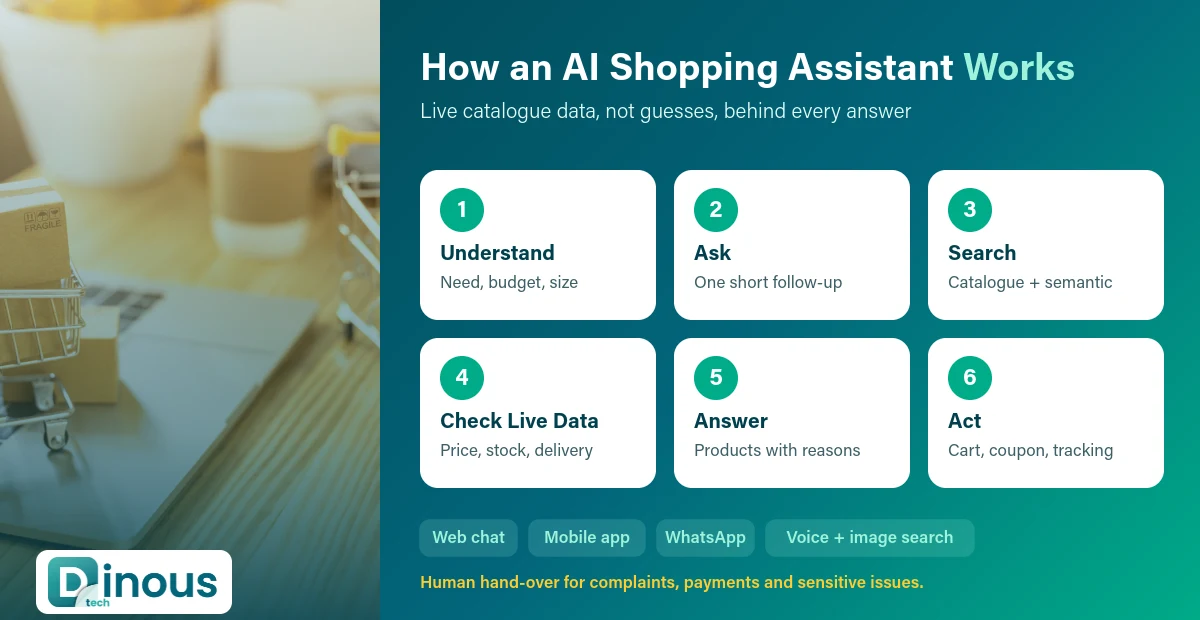
- Understand the request. The LLM reads the message and pulls out intent and details such as category, budget, size, colour and use.
- Ask if needed. If something important is missing, it asks one short follow-up question.
- Search the catalogue. It calls your product search with filters and a semantic (vector) search, so "comfy shoes for long walks" finds the right items even without exact keywords.
- Check live data. Prices, stock, delivery estimates and offers come from your systems through APIs at that moment.
- Answer with reasons. It shows a few products with short explanations, ratings and links, using only the data it retrieved.
- Take action. With the shopper's go-ahead, it adds items to the cart, applies a valid coupon or opens order tracking.
- Hand over when needed. Complaints, payment problems or sensitive issues go to a human agent with the full conversation.
- Learn from results. Conversations, clicks and orders are reviewed to improve prompts, search ranking and product data.
This pattern, where the model looks up real data before answering, is called retrieval-augmented generation (RAG). It keeps answers accurate and stops the assistant from inventing products or prices.
Key Features to Build
Shopper features
- Natural language search and follow-up questions
- Product cards with images, price, rating and "why this fits"
- Side-by-side comparison
- Size and fit help based on product size charts
- Image search ("find something like this photo")
- Voice input in the app
- Multilingual chat for global stores
- Add to cart, wishlist and checkout links
- Order tracking, returns and exchange requests
Admin and business features
- Brand tone and persona settings
- Rules for what the assistant may and may not say or recommend
- Promotions and featured products the assistant can suggest
- Conversation logs, search gaps ("products people asked for that you do not stock")
- Analytics on conversion, revenue influenced and hand-overs
- Human agent console for live hand-over
- A/B testing of prompts and recommendation strategies
Tech Stack
| Layer | Common choices |
|---|---|
| LLM | Hosted models from major AI providers, or open-source models hosted on your cloud |
| Orchestration | Python or Node.js service with tool calling (search, cart, orders), frameworks such as LangChain or LlamaIndex where useful |
| Search and retrieval | Elasticsearch or OpenSearch, a vector database (pgvector, Pinecone, Weaviate) and hybrid ranking |
| Commerce platform | Shopify, Magento (Adobe Commerce), WooCommerce or a custom backend via APIs |
| Frontend | Web chat widget in React or Next.js; native or Flutter components in mobile apps |
| Messaging | WhatsApp Business Platform, Instagram messaging APIs |
| Data and analytics | PostgreSQL, a data warehouse, event tracking and dashboards |
| Safety and monitoring | Input and output filters, rate limits, logging, evaluation sets and cost monitoring |
Step-by-Step Development Process
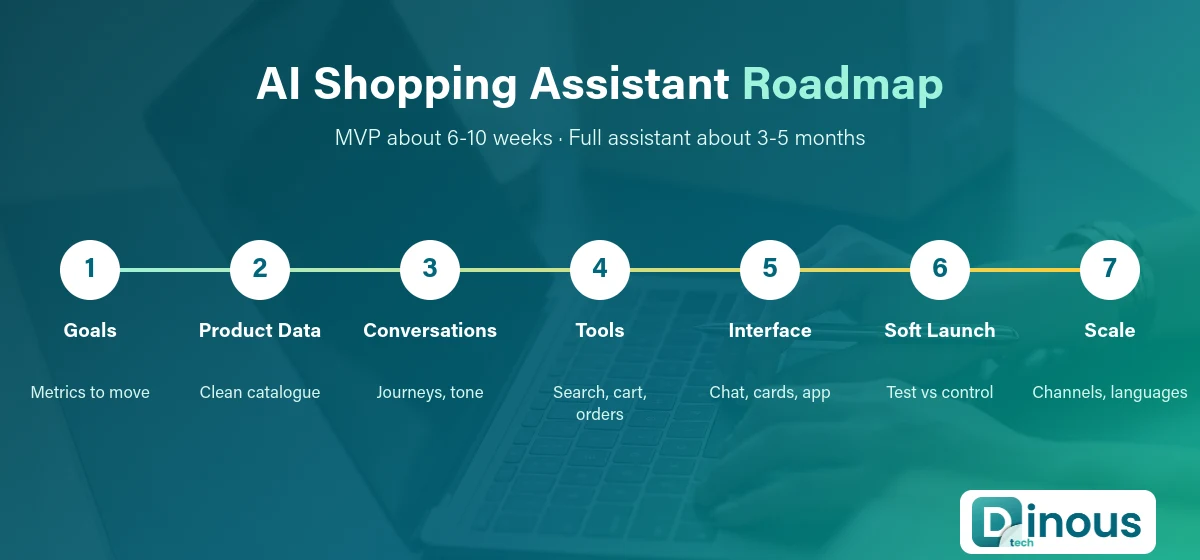
- Pick the goal. For example "help shoppers find the right product faster" or "cut order-status tickets". Choose two or three metrics.
- Prepare product data. Clean titles, attributes, size charts and descriptions. Good catalogue data is the biggest quality lever.
- Design conversations. Map the main journeys, tone of voice, follow-up questions and hand-over rules.
- Build retrieval and tools. Connect search, stock, pricing, cart and order APIs that the model can call.
- Build the interface. Chat widget, product cards and in-app screens that match your brand.
- Test with real questions. Create an evaluation set from real customer queries; check accuracy, tone and safety.
- Soft launch. Release to a share of traffic, compare against shoppers without the assistant and tune.
- Scale and extend. Add channels, languages, voice and image search, and personalisation.
How Dinoustech Uses AI
- AI-assisted development: our developers use AI coding tools to speed up integration code, tests and documentation, while engineers review every change.
- AI features in your store: the shopping assistant itself, plus related features such as smart search, product description generation, review summaries and personalised recommendations through our generative AI development services.
- AI support agents: after-sales agents that handle order status, returns and FAQs, and pass complex cases to your team. See our AI agent development services.
Privacy, Safety and Compliance
- Consent and data use: only use purchase history and preferences in line with your privacy policy and laws such as GDPR, CCPA/CPRA and India's DPDP Act.
- No invented facts: the assistant should answer only from retrieved product and policy data and say "I am not sure" when data is missing.
- Clear disclosure: tell shoppers they are chatting with an AI assistant and how to reach a human.
- Payment safety: never collect card details in chat; send shoppers to your secure checkout.
- Guardrails: block harmful or off-topic requests and protect against prompt injection.
- Accessibility: make the chat usable with screen readers and keyboards.
This is general guidance, not legal advice. Check the rules for your markets with your legal advisor.
How to Measure Success
- Conversion rate of shoppers who use the assistant vs those who do not
- Average order value and add-on rate
- Search exits and "no result" searches
- Return rate (better fit advice should reduce wrong-size returns)
- Support tickets handled without a human, and customer satisfaction
- AI usage cost per conversation and per order
Custom Build vs Off-the-Shelf Plugin
Many platforms offer ready-made AI chat plugins. They can be a good start, but a custom assistant makes sense when your needs go beyond the basics.
| Option | Good when | Limits |
|---|---|---|
| Off-the-shelf plugin | Small catalogue, standard platform, mainly FAQs and simple search | Monthly fees per conversation, limited control over data, ranking and design |
| Custom assistant | Large or complex catalogue, custom backend, several channels, own brand experience | Higher upfront build cost and the need for ongoing tuning |
| Hybrid | Use a plugin for support FAQs and a custom layer for product discovery | Two systems to manage |
A custom build also lets you own your conversation data and reuse the same AI layer across your website, app, WhatsApp and in-store tools. If you are unsure, start with a short discovery phase: we review your catalogue, traffic and support tickets and recommend the simplest option that meets your goals.
Cost Factors
The cost of an AI shopping assistant depends on:
- Catalogue size and data quality: messy product data adds clean-up work.
- Channels: web only, or web plus app, WhatsApp and voice.
- Integrations: commerce platform, search, inventory, order management, CRM and helpdesk.
- Actions: answering questions is simpler than cart, coupon and returns actions.
- Languages and personalisation depth.
- Running costs: LLM usage per conversation, vector database and hosting, which grow with traffic.
- Ongoing tuning: evaluation, prompt updates and new features after launch.
Use our free app cost calculator for a quick first estimate, or read how much it costs to build an eCommerce app.
Development Timeline
| Scope | What is included | Typical timeline |
|---|---|---|
| MVP | Web chat, product discovery and Q&A on one platform, basic analytics | About 6-10 weeks |
| Full assistant | Web + app, cart and order actions, human hand-over, multilingual | About 3-5 months |
| Advanced | Voice, image search, WhatsApp, deep personalisation, several stores or regions | 5-8 months or more |
Challenges and How to Solve Them
- Wrong or made-up answers: use retrieval with strict instructions, and test against a set of real questions before every release.
- Slow responses: stream answers, cache common searches and keep tool calls lean.
- Rising AI costs: route simple questions to smaller models, cap conversation length and monitor cost per order.
- Poor product data: fix attributes and size charts; the assistant can only be as good as the catalogue.
- Pushy selling: limit upsell suggestions and keep the focus on what the shopper asked for.
Why Choose Dinoustech
Dinoustech is a software development company whose team has 7+ years of experience and 450+ delivered projects, including eCommerce stores, marketplaces, grocery and delivery apps. We combine eCommerce engineering with practical AI, so your assistant is connected to real stock, prices and orders from day one.
- Experience with Shopify, WooCommerce, Magento and custom commerce backends
- Marketplace and multi-vendor platform experience
- AI chatbot development and AI app development under one roof
- Clients in the USA, UK, UAE, Australia and India
See our portfolio for live projects.
Build Your AI Shopping Assistant
Want shoppers to find the right product faster and buy with confidence? Contact Dinoustech for a free consultation, and we will map the first version of your AI shopping assistant around your catalogue and goals.