Dinoustech Private Limited
How to Build an AI-Powered Jewellery Shopping App?
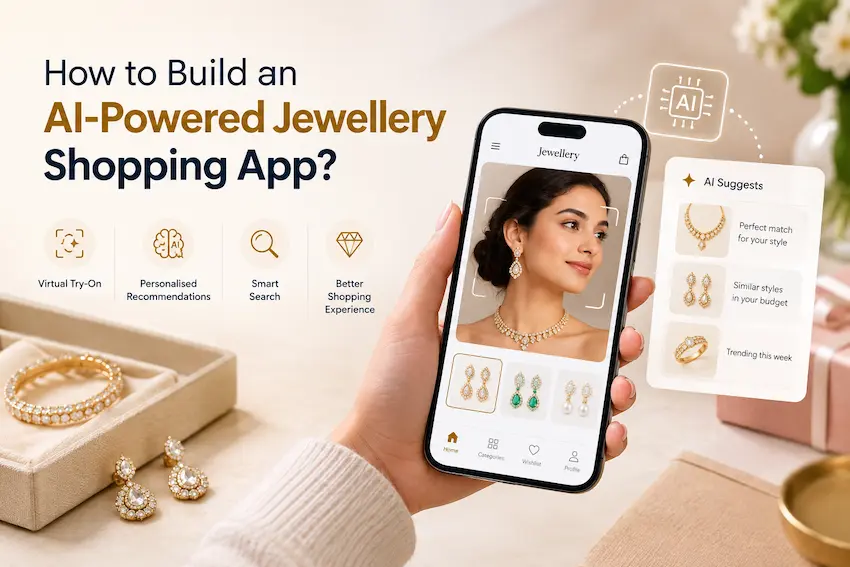
Jewellery shopping is moving beyond physical stores and basic e-commerce websites. Customers now expect better product discovery, personalized recommendations, detailed product information, secure payments, flexible delivery options, and a shopping experience that helps them make confident decisions online.
Artificial intelligence can take a jewellery shopping app further. AI can recommend products based on preferences, understand natural-language searches, analyse jewellery images, support virtual try-on experiences, answer customer questions, and help shoppers compare products more easily.
The market opportunity is significant. Grand View Research estimates that the India jewellery market was valued at USD 94.14 billion in 2025 and could reach USD 153.77 billion by 2033, growing at a CAGR of 6.5% from 2026 to 2033. Online retail is currently a smaller part of the market, but Grand View Research expects online jewellery sales in India to grow at the fastest distribution-channel CAGR of 9.3% from 2026 to 2033.
CareEdge research cited in a SEBI-filed industry document estimates that India's online jewellery market could increase from around ₹262 billion in 2024 to ₹743 billion by 2029, representing a CAGR of 23.2%.
At the same time, AI is becoming part of the shopping journey. Adobe's 2026 retail research reports that 25% of consumers cite AI-powered platforms as a top source for information, purchase decisions, and recommendations, ahead of brand websites and online reviews.
These trends create an opportunity for jewellery brands to build mobile experiences that combine e-commerce convenience with AI-powered personalisation.
What Is an AI-Powered Jewellery Shopping App?
An AI-powered jewellery shopping app is a mobile commerce platform that allows customers to browse, compare, personalise, and purchase jewellery while using artificial intelligence to improve different parts of the shopping journey.
A standard jewellery app may include product listings, categories, search, filters, wishlists, shopping carts, payments, and order tracking. An AI-powered version can add intelligent recommendations, visual search, virtual try-on, conversational shopping, personalised offers, product matching, and customer support.
The app can learn from authorised customer interactions such as product views, searches, wishlists, purchases, preferred jewellery types, price ranges, and style preferences. It can then use this information to make relevant recommendations.
For example, a customer looking for lightweight earrings for a wedding could describe the requirement in normal language. An AI shopping assistant could understand the request and display relevant products based on price, material, design, occasion, and other available attributes.
The objective is not to make the app complicated. The objective is to reduce the effort required to find the right jewellery.
Why Should Jewellery Brands Invest in an AI Shopping App?
Jewellery often requires more consideration than everyday purchases. Customers may compare designs, materials, stone details, sizes, prices, certifications, return policies, delivery options, and brand reputation before completing a purchase.
An AI-powered jewellery application can help organise this information and reduce uncertainty. Personalised recommendations can narrow down product choices, while conversational search can help customers explain what they want without using exact product keywords.
The opportunity is particularly relevant as India's digital commerce market expands. Google and Deloitte reported in April 2026 that India's e-commerce market is expected to reach $250 billion by 2030, up from about $90 billion at the time of the report. The report also highlights increasing demand for digital-led discovery and hyper-personalised shopping.
Jewellery brands can use this shift to build stronger mobile relationships with customers instead of relying entirely on marketplaces or social media platforms.
An app can also connect online and offline experiences. Customers can browse products online, save favourites, check store availability, book appointments, request consultations, and then visit a physical showroom before purchasing.
Also Read: - Build a Custom Ecommerce Website in 2026: A Complete Development Guide
What AI Features Should a Jewellery Shopping App Include?
AI recommendations are one of the most practical features. The system can analyse product attributes and customer behaviour to suggest earrings, rings, necklaces, bracelets, pendants, or other products that match a user's preferences.
A recommendation engine can consider factors such as material, colour, price range, product category, occasion, previous purchases, and browsing behaviour. Over time, recommendations can become more relevant as the system receives additional user interactions.
AI-powered visual search can provide another useful shopping experience. A customer can upload an image of a jewellery design and the application can identify visually similar products from the brand's catalogue.
Virtual try-on can help address one of the biggest challenges in online jewellery shopping: uncertainty about how a piece may look when worn. Augmented reality and computer vision can allow users to preview selected earrings, necklaces, rings, or other products using a smartphone camera. The accuracy will depend on the product category, device capabilities, calibration, and implementation.
Conversational AI can turn the app into an AI jewellery shopping assistant. Customers can ask questions such as, "Show me gold earrings under ₹10,000," or "I need a lightweight necklace for a wedding," and the application can convert the request into relevant search criteria.
Generative AI can also support product discovery and customer support. It can summarise product information, answer common questions, compare selected items, and create personalised shopping guidance using approved catalogue data.
How Can AI Personalise Jewellery Recommendations?
Personalisation works best when the app understands customer intent without becoming intrusive.
The recommendation engine can evaluate what a user browses, saves, compares, and buys. It can then identify patterns and recommend similar or complementary products.
For example, a customer who frequently views minimalist gold earrings may receive recommendations from the same design family. Someone shopping for a necklace may also receive matching earrings or bracelets.
AI can also personalise recommendations around occasions. A customer searching for wedding jewellery may receive a different product mix from someone searching for everyday office accessories.
Price sensitivity can also play a role. Instead of showing thousands of products, the system can prioritise items within the user's preferred price range.
NielsenIQ's 2026 analysis describes a broader shift from conventional search toward conversational product discovery, where AI increasingly helps consumers find, evaluate, and choose products.
For jewellery brands, this creates an opportunity to turn product catalogues into personalised shopping experiences instead of static collections.
How Does AI-Powered Search Improve Jewellery Discovery?
Traditional e-commerce search often depends on exact keywords. A customer searching for "gold earrings" may receive relevant results, but a customer typing "small lightweight earrings for a wedding under ₹15,000" needs a much more intelligent search system.
Natural-language search can understand phrases such as:
"Show me simple diamond earrings for daily wear."
"Find a necklace for a wedding under ₹50,000."
"Show me rose-gold jewellery similar to this photo."
"Which earrings will match this necklace?"
The backend can convert these requests into structured filters and ranking signals. AI can then combine product catalogue data with customer preferences to produce relevant results.
Visual search adds another dimension. Instead of describing an item, users can upload a photo and search for similar shapes, colours, patterns, or styles.
This matters for AEO and GEO as well. As product discovery increasingly happens through conversational AI interfaces, jewellery brands need structured product data, clear descriptions, accurate attributes, strong entity information, and machine-readable content so AI systems can understand their catalogues.
Deloitte's 2026 retail research notes that AI-led shopping is becoming a distinct commerce channel and identifies clear, structured data as an important foundation for discoverability within AI interfaces.
Must Read: - Why Every Retail Business Needs an E-commerce App in 2026
Must-Have E-commerce Features for a Jewellery App
AI should sit on top of a reliable e-commerce foundation. Customers still need a straightforward way to browse products, check details, add items to a wishlist, manage their cart, complete payments, and track orders.
Each jewellery product page should provide high-quality images, pricing, material information, stone details where applicable, available sizes, weight information where relevant, certifications, shipping details, return policies, care instructions, and other information necessary for an informed purchase.
Wishlist and comparison features can help customers save products before making a decision. Customers can compare multiple pieces based on price, material, design, ratings, or other product attributes.
Secure checkout is essential. The application can support payment gateways, UPI, cards, wallets, EMI options, and other applicable methods depending on the target market and payment partners.
Order tracking should provide clear updates from confirmation through delivery. Customers should also have access to invoices, refunds, returns, customer support, and order history.
For jewellery brands with physical stores, the app can add store locator functionality, appointment booking, product availability checks, and showroom consultation requests.
How to Build a Secure and Scalable Jewellery Shopping App?
Jewellery applications handle customer profiles, addresses, payments, orders, and sometimes high-value transactions. Security therefore needs to be included from the beginning.
The application should use secure authentication, encrypted communication, protected APIs, access controls, secure payment processing, audit logs, and monitoring. Sensitive payment information should be handled through appropriate payment providers rather than stored unnecessarily inside the application.
Fraud prevention is also important. AI can help detect unusual account activity, suspicious orders, abnormal transaction patterns, or other signals that warrant additional verification.
The backend should support product catalogue management, inventory synchronisation, pricing, promotions, orders, customer data, payments, shipping, returns, and analytics.
A scalable cloud architecture can help the application handle seasonal traffic during weddings, festivals, promotional campaigns, and high-demand product launches.
The application should also be tested across different devices and network conditions. Jewellery shoppers may access the app through smartphones with different screen sizes, operating systems, and connection speeds.
What Technology Stack Can Power an AI Jewellery App?
A cross-platform framework such as React Native or Flutter can support Android and iOS applications from a shared development approach. Native Android and iOS development can also be considered when the application requires extensive platform-specific functionality.
The backend can use Node.js, Python, Java, .NET, Laravel, or another suitable technology depending on the application's architecture. PostgreSQL, MySQL, MongoDB, or another appropriate database can manage customer, product, order, and operational data.
AI functionality can connect with recommendation engines, large language models, vector databases, computer vision systems, image-processing APIs, or custom machine learning models.
Cloud platforms such as AWS, Microsoft Azure, and Google Cloud can support storage, APIs, databases, analytics, monitoring, and scalable infrastructure.
An enterprise-grade analytics layer can track search behaviour, product engagement, conversion, abandoned carts, recommendation performance, and customer retention.
The technology should remain flexible enough to support future AI upgrades. A brand may start with AI recommendations and later add conversational commerce, visual search, virtual try-on, AI agents, or other capabilities.
Also Read: - How Can You Optimize Costs While Developing a Feature-Rich E-commerce App?
How to Develop an AI-Powered Jewellery Shopping App Step by Step?
The first stage is market and user research. Identify your target customers, preferred jewellery categories, price ranges, shopping behaviour, geographic markets, and major customer concerns.
Next, define the MVP. A focused first version may include product discovery, search, filters, product details, wishlist, cart, secure checkout, order tracking, and one or two AI features such as recommendations or conversational search.
The design process should use real customers. Test product discovery, filters, product pages, checkout, and AI interactions with representative users before development progresses too far.
Developers then build the mobile application, backend, product catalogue, payments, order system, customer accounts, admin dashboard, analytics, and AI services.
The AI layer should be tested separately. The team should measure recommendation relevance, chatbot accuracy, image-search results, response speed, and incorrect or misleading outputs.
After launch, monitor search terms, product views, conversion rates, abandoned carts, repeat purchases, AI feature usage, and customer feedback. Use this data to improve product recommendations, search relevance, UI design, and marketing campaigns.
Continuous experimentation can include new AI recommendation models, virtual try-on features, conversational shopping flows, loyalty features, social commerce integrations, and personalized offers.
How Much Does It Cost to Build an AI Jewellery Shopping App?
The cost of jewellery shopping app development depends on the application's features, number of platforms, catalogue size, AI functionality, payment integrations, design complexity, backend architecture, and administrative requirements.
A basic jewellery shopping app with product listings, search, filters, wishlist, cart, payments, order tracking, and an admin panel may cost approximately $25,000 to $50,000.
A medium-level application with AI recommendations, conversational search, advanced customer accounts, multiple payment options, inventory integration, analytics, and personalised shopping features may cost around $50,000 to $100,000.
A large AI-powered jewellery commerce platform with visual search, virtual try-on, advanced recommendation systems, AI shopping assistants, ERP integrations, loyalty systems, omnichannel capabilities, and enterprise infrastructure can cost $100,000 to $200,000+.
A focused MVP can take around three to five months. A medium-level platform may require five to eight months, while an advanced jewellery commerce ecosystem can take eight to twelve months or longer.
Businesses should also budget for cloud hosting, AI model usage, payment gateway charges, image processing, third-party APIs, maintenance, security, and future product enhancements.
How to Choose a Jewellery App Development Company?
A jewellery shopping app development company should understand both e-commerce and the specific requirements of jewellery retail. Product attributes, high-quality visual content, product discovery, trust, payments, returns, inventory, and customer experience all matter.
A jewellery mobile application development company should also be comfortable working with AI capabilities such as recommendation engines, natural-language search, visual search, generative AI, virtual try-on, and customer support automation.
Businesses searching for ecommerce mobile app developers should review the team's experience with product catalogues, payment integration, mobile checkout, cloud architecture, analytics, security, and third-party integrations.
Ask the development partner how it will structure the product catalogue, protect customer data, integrate payment services, manage AI APIs, monitor recommendation quality, and improve the platform after launch.
It is also useful to ask for a clear development roadmap that separates the MVP from advanced features. This helps control initial costs while leaving room for future AI capabilities.
Dinoustech is an AI-based software and web development company that can help businesses build e-commerce mobile applications, jewellery shopping platforms, AI-powered commerce solutions, custom software, and mobile applications.
Future Trends in AI-Powered Jewellery Shopping Apps
The next phase of jewellery e-commerce will increasingly combine AI with conversational and visual shopping experiences.
AI shopping assistants can help customers search, compare, and make product decisions through natural-language conversations. Adobe's 2026 retail research found that one in four shoppers now turn to AI-powered platforms for product information, recommendations, and purchase decisions.
Agentic commerce is another emerging area. Instead of simply answering a customer's question, an AI agent can potentially search products, compare options, apply approved preferences, and assist with parts of the purchasing process. However, current research and industry discussions also highlight concerns around privacy, fraud, transparency, and consumer protection when AI agents become involved in transactions.
Virtual try-on and computer vision can make jewellery shopping more visual. Customers may eventually use their phone cameras to see how earrings, rings, necklaces, or other products could look before buying.
AI-powered style assistants can also combine multiple products into personalized recommendations. For example, a customer buying a necklace could receive coordinated earrings and bracelets based on colour, design, occasion, and personal preferences.
Product data will become increasingly important for GEO. Jewellery brands should maintain clear product titles, structured attributes, accurate descriptions, material information, sizes, pricing, availability, images, policies, and other machine-readable information so search engines and AI shopping systems can understand their products.
The brands that benefit from these developments will not necessarily be the ones with the most AI features. The focus should remain on useful shopping experiences, accurate product information, secure transactions, strong customer trust, and continuous improvement based on real user behaviour.
Conclusion
Building an AI-powered jewellery shopping app requires a combination of strong e-commerce fundamentals and practical AI features. The foundation should include accurate product data, intuitive search, secure checkout, reliable order management, mobile-first design, and strong customer support.
AI can then improve the shopping journey through recommendations, conversational search, visual discovery, virtual try-on, personalized product matching, and intelligent customer assistance.
The market data points to a growing opportunity for online jewellery retail in India, while AI is changing how consumers discover and evaluate products.
For a jewellery brand, the most practical strategy is to start with a focused mobile commerce product, validate it with real users, measure customer behaviour, and gradually add AI capabilities that solve genuine shopping problems.
A well-planned AI jewellery shopping app development strategy can help a brand create a more personalised mobile storefront while preparing its product catalogue and customer experience for the growing role of AI-powered and conversational commerce.
Frequently Asked Questions
What is an AI-powered jewellery shopping app?
It is a jewellery e-commerce mobile application that uses AI for features such as personalized recommendations, conversational search, visual search, virtual try-on, customer support, and shopping assistance.
What AI features should a jewellery shopping app have?
Useful features include AI product recommendations, visual search, conversational shopping, virtual try-on, AI shopping assistants, personalised product matching, image recognition, and intelligent customer support.
How much does it cost to build an AI jewellery shopping app?
A basic app may cost around $25,000 to $50,000, while an advanced platform with AI recommendations, virtual try-on, visual search, integrations, and other enterprise features can cost $100,000 to $200,000 or more.
How long does it take to develop a jewellery shopping app?
A focused MVP can take around three to five months. A medium application may take five to eight months, while an advanced AI-powered platform can require eight to twelve months or longer.
Can AI help customers find jewellery from an image?
Yes. Computer vision and visual-search technology can analyse an uploaded image and identify visually similar products from an available catalogue.
Can AI provide jewellery recommendations?
Yes. AI can use product attributes and authorised customer behaviour to recommend jewellery based on style, price range, material, occasion, and other relevant preferences.
How can AI improve jewellery e-commerce conversion rates?
AI can make product discovery faster, personalise recommendations, answer product questions, improve search relevance, reduce decision friction, and support customers during the buying process.
What is conversational commerce for jewellery shopping?
Conversational commerce allows customers to search for and compare jewellery through natural-language interactions with an AI assistant rather than relying only on traditional filters and keyword searches.