Dinoustech Private Limited
What Is the Cost of Developing a Chatbot in 2026?
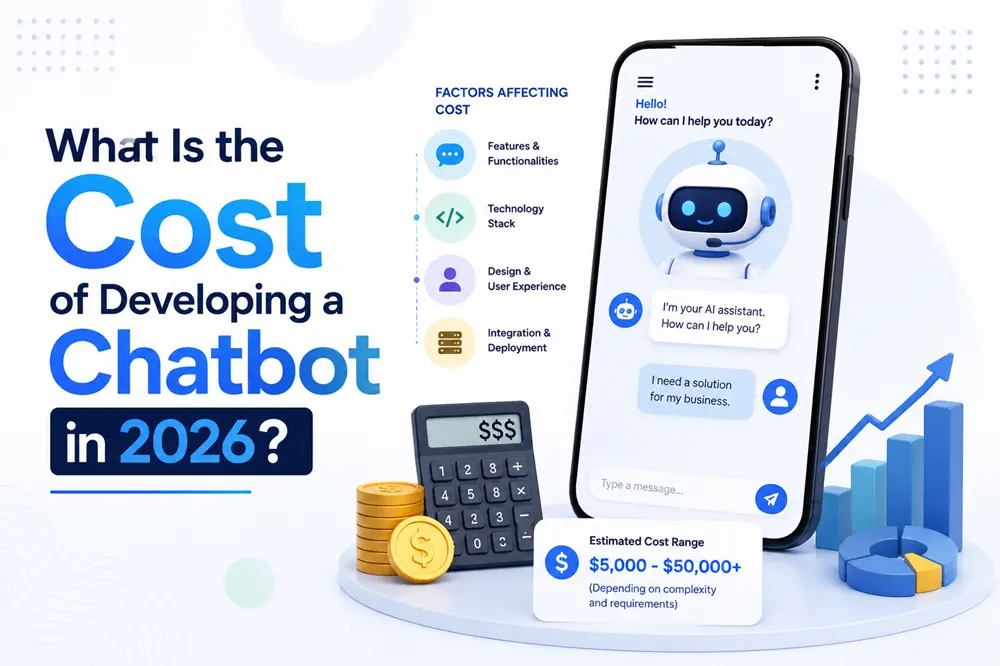
The cost of developing a chatbot in 2026 usually ranges from $5,000 to $150,000 or more, depending on the chatbot’s features, AI capabilities, integrations, design, and development team. A basic rule-based chatbot costs much less than an AI-powered chatbot that understands natural language, connects with business systems, and supports voice conversations.
Businesses now use chatbots for customer support, lead generation, sales, appointment booking, internal communication, and personalised recommendations. The right chatbot can reduce response time, handle repetitive tasks, and support customers around the clock. However, the final development cost depends on the business problem the chatbot needs to solve.
This guide explains chatbot development costs in 2026, the factors that affect pricing, essential features, AI technologies, development timelines, and ways to build a chatbot that delivers measurable business value.
Chatbot Development Cost in 2026
The average chatbot development cost depends on the type of solution a business chooses. A basic chatbot with fixed responses and limited workflows may cost between $5,000 and $15,000. A chatbot with custom business logic, API integrations, user authentication, and an admin panel may cost between $15,000 and $40,000.
An AI chatbot that uses natural language processing, large language models, knowledge bases, analytics, and advanced automation may cost between $40,000 and $100,000. Enterprise-level conversational AI platforms with voice support, multilingual communication, complex integrations, advanced security, and custom AI models can cost $100,000 to $150,000 or more.
These figures provide a general estimate. A chatbot development company may charge more when the project requires healthcare compliance, financial data protection, real-time recommendations, complex workflows, or high-volume conversations.
|
Chatbot Type |
Estimated Development Cost |
|
Basic rule-based chatbot |
$5,000–$15,000 |
|
Website or customer support chatbot |
$10,000–$25,000 |
|
Custom business chatbot |
$15,000–$40,000 |
|
AI chatbot with LLM integration |
$40,000–$100,000 |
|
Enterprise conversational AI platform |
$100,000–$150,000+ |
The final budget should include development, testing, AI model usage, hosting, maintenance, security updates, and future improvements.
Chatbot Market Size and Growth in 2026
The chatbot industry continues to grow as companies invest in automation and AI-powered customer experiences. Fortune Business Insights estimates that the global chatbot market will grow from $8.37 billion in 2025 to $10.42 billion in 2026, and it may reach $60.21 billion by 2034, with a compound annual growth rate of 24.51%.
Grand View Research estimates the global chatbot market at approximately $11.8 billion in 2026, with a projected value of $41.2 billion by 2033. Its research identifies customer service, e-commerce, mobile applications, and AI-powered business automation as major growth areas.
India is also becoming an important market for conversational AI. Ken Research estimates that the India conversational AI market will grow from $575 million in 2025 to $2.345 billion by 2031, at a CAGR of 26.40%. The report also highlights the growing use of voice-enabled and multilingual AI solutions.
These numbers show why businesses in India, the USA, the UAE, Saudi Arabia, and other markets are investing in chatbot development. However, companies should focus on solving real customer problems instead of adding AI features without a clear purpose.
Also Read: - Top AI Trends in 2026: What Every Business Should Know
Main Factors That Affect Chatbot Development Cost
The chatbot’s purpose is one of the biggest cost factors. A chatbot that answers frequently asked questions need less development work than a chatbot that processes orders, checks account details, schedules appointments, or connects with a CRM.
The number of platforms also affects the budget. A website chatbot may require a simple web integration, while a chatbot for WhatsApp, Facebook Messenger, mobile apps, and voice channels needs additional APIs, testing, and maintenance. Each platform may have its own usage limits and pricing rules.
The level of intelligence also changes the cost. Rule-based chatbots follow fixed decision trees. AI chatbots understand user intent and generate responses based on training data, documents, or connected knowledge sources. Advanced systems may also use retrieval-augmented generation, sentiment analysis, speech recognition, and predictive analytics.
Data security, language support, user roles, analytics, and third-party integrations also increase development time. A business should define these requirements before requesting a quotation from a chatbot development company.
Types of Chatbots Businesses Can Develop
A rule-based chatbot uses predefined questions, buttons, and responses. It works well for simple tasks such as sharing business hours, collecting contact details, answering FAQs, and guiding users through a fixed process. This type of chatbot offers a lower development cost but cannot handle complex or unexpected questions effectively.
An AI chatbot uses natural language processing and machine learning to understand user messages. It can answer questions in different ways, maintain conversation context, and provide more flexible support. Businesses often use AI chatbots for customer service, product recommendations, employee support, and lead qualification.
A generative AI chatbot uses a large language model to create responses based on user questions and connected business information. Developers can connect the chatbot to company documents, product catalogues, policies, and internal databases. The system should use a controlled knowledge source to reduce incorrect answers.
A voice chatbot allows users to speak instead of typing. It combines speech recognition, natural language understanding, and text-to-speech technology. Voice chatbots work well for call centres, appointment booking, travel services, banking support, and hands-free customer assistance.
Must-Have Features of an AI Chatbot
A successful chatbot needs more than a chat window. It should understand user intent, provide useful answers, and guide users toward the next action. A clear conversation flow helps user’s complete tasks without confusion.
The chatbot should support natural language input, fallback responses, conversation history, and human-agent handover. When the chatbot cannot answer a question, it should clearly explain the limitation and connect the user with a support executive when required.
A knowledge base allows the chatbot to answer questions using approved business information. Developers can connect FAQs, product details, service pages, policy documents, and support articles. The business should update this information regularly to keep responses accurate.
Other important features include multilingual support, user authentication, payment integration, appointment scheduling, lead capture, CRM integration, analytics, push notifications, and an admin dashboard. The required features should match the users’ needs and the business’s operating model.
Must Read: - AI Chatbot Development Services: Everything You Need to Know
AI Technologies Used in Chatbot Development
Modern chatbots use several AI technologies. Natural language processing helps the system understand written language, while natural language understanding identifies the user’s intent. Machine learning helps the chatbot improve its responses through conversation data and feedback.
Large language models support flexible and human-like conversations. Developers can connect these models with a business knowledge base through retrieval-augmented generation. This approach helps the chatbot provide responses based on relevant company information instead of relying only on general model knowledge.
AI chatbots can also use sentiment analysis to identify frustrated or dissatisfied users. The system can then prioritise the conversation or transfer it to a human agent. Speech-to-text and text-to-speech technologies support voice-based communication.
In 2026, businesses are also adopting AI agents that can perform tasks instead of only answering questions. An AI agent may check inventory, create a support ticket, schedule a meeting, generate a quotation, or update a CRM record after receiving user permission.
Industry-Specific Chatbot Development Examples
Businesses can build chatbots for almost every industry. E-commerce companies use them to recommend products, track orders, answer return questions, and recover abandoned carts. Banks use chatbots for account support, transaction information, loan queries, and customer verification.
Healthcare organisations use AI chatbots for appointment booking, patient navigation, reminders, and basic health information. These systems must follow strict privacy and safety requirements. A healthcare chatbot should not provide unsupported medical diagnoses or replace qualified professionals.
Education companies use chatbots to answer course questions, guide students, share learning resources, and support admissions. Travel companies use them for booking assistance, itinerary updates, cancellations, and destination information.
These examples show that chatbot development should begin with a specific business use case. A focused chatbot often delivers better results than a large system with too many unrelated features.
Chatbot Development Process
The first step is to define the chatbot’s purpose, target users, and expected results. The business should identify the questions users ask most often and the tasks that consume the support team’s time. This research helps developers select the right chatbot type and technology.
The next step involves planning the conversation flow, user interface, integrations, and knowledge base. The team should prepare sample questions, fallback responses, escalation rules, and data protection requirements before development begins.
During development, programmers build the chatbot interface, backend, AI layer, database, and third-party integrations. They also configure the knowledge base and train the system to understand common user intents.
Testing should cover accuracy, response time, security, usability, multilingual communication, and unexpected questions. After launch, the business should monitor conversations, identify weak responses, update the knowledge base, and improve the chatbot based on real user behaviour.
Also Read: - How AI Is Shaping Banking App Development
Technology Stack for Chatbot Development
The technology stack depends on the chatbot’s complexity and deployment requirements. Developers may use React, Angular, or Vue.js for the frontend and Node.js, Python, Laravel, or another backend framework for server-side development.
Python is commonly used for AI, machine learning, natural language processing, and data processing. Developers may connect the chatbot with large language models through APIs or use open-source models when the project requires greater control over data and infrastructure.
A chatbot may use PostgreSQL, MySQL, or MongoDB for data storage. Cloud platforms such as AWS, Microsoft Azure, and Google Cloud can support hosting, monitoring, authentication, and scaling.
The final stack should support secure API communication, access control, logging, analytics, model monitoring, and regular updates. Businesses should avoid selecting technologies only because they are popular. The stack must fit the chatbot’s actual requirements.
Additional Costs After Development
The initial development budget does not cover every chatbot expense. AI model providers may charge based on the number of requests, tokens, audio minutes, or processed documents. High traffic can increase monthly operating costs.
Hosting, database storage, monitoring, security tools, domain services, and third-party APIs also create recurring expenses. WhatsApp, SMS, payment gateways, CRM tools, and voice services may charge separate usage fees.
Businesses should also budget for chatbot maintenance. Developers may need to fix bugs, update integrations, improve AI responses, add new languages, refresh the knowledge base, and adjust the chatbot to changing customer needs.
A basic chatbot may cost between $100 and $500 per month to operate, while an advanced AI chatbot may cost $1,000 to $10,000 or more per month, depending on traffic, model usage, hosting, and integrations.
How to Reduce Chatbot Development Cost
Businesses can reduce development costs by launching a minimum viable chatbot first. The initial version should solve one or two important problems, such as answering FAQs, collecting leads, or booking appointments. The company can add advanced features after measuring user demand.
Using existing AI APIs can reduce the cost and time required to build a custom language model. However, businesses should compare API pricing, data policies, response quality, and long-term operating costs before selecting a provider.
A well-organised knowledge base also reduces development and maintenance work. Clear documents, updated FAQs, and structured product information help the chatbot provide more accurate answers.
Businesses should also select a development team with experience in AI chatbot development, API integration, cloud deployment, and security. Dinoustech is an AI-based software and web development company that can help businesses plan, develop, integrate, and maintain custom chatbot solutions based on their operational needs.
Final Thoughts
The cost of developing a chatbot in 2026 depends on the chatbot’s purpose, AI capabilities, integrations, security requirements, and expected user volume. A basic chatbot can support simple customer interactions, while an AI-powered platform can automate complex tasks and improve business operations.
The best approach is to start with a clear use case, build a practical first version, measure real user behaviour, and improve the system continuously. Businesses that combine useful AI features with accurate information, human support, strong security, and regular optimisation can create chatbots that deliver long-term value.
Frequently Asked Questions
How much does it cost to develop a chatbot in 2026?
A basic chatbot may cost between $5,000 and $15,000. A custom AI chatbot may cost between $40,000 and $100,000, while an enterprise chatbot can cost $150,000 or more.
How long does it take to develop a chatbot?
A basic chatbot may take four to eight weeks. A custom AI chatbot usually takes eight to sixteen weeks. Enterprise chatbot development may take four to nine months because of complex integrations, testing, security, and compliance requirements.
Is an AI chatbot more expensive than a rule-based chatbot?
Yes. AI chatbots require language processing, model integration, knowledge management, testing, and ongoing monitoring. They offer more flexible conversations but usually require a higher development and maintenance budget.
Can a chatbot connect with a CRM or business software?
Yes. Developers can connect chatbots with CRM systems, payment gateways, inventory software, booking platforms, helpdesk tools, and enterprise applications through APIs.
What is the best way to start chatbot development?
Start by identifying the most common customer questions and repetitive business tasks. Then choose the chatbot type, define the required features, prepare the knowledge base, and launch a focused first version.
Should a business build or buy a chatbot?
A ready-made chatbot may suit businesses with simple requirements. Custom chatbot development is more suitable when the business needs unique workflows, advanced AI, industry-specific security, custom integrations, or complete control over the user experience.