Dinoustech Private Limited
How to Build a Dating App with AI-Based Profile Matching?
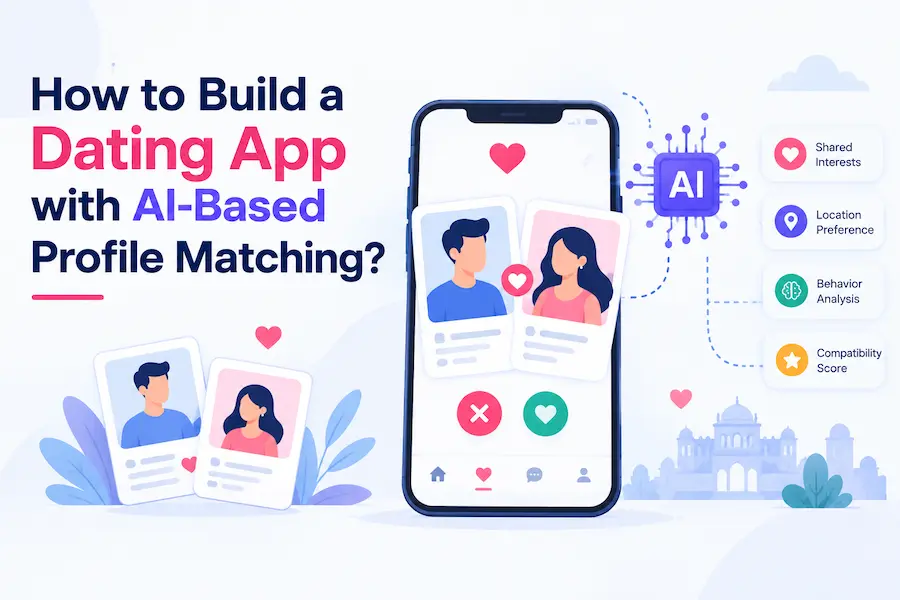
Dating apps have changed how people meet, communicate, and build relationships. Users now expect more than simple swiping. They want relevant matches, better profile recommendations, authentic users, meaningful conversations, strong privacy controls, and a safer mobile experience.
Artificial intelligence can improve many of these areas. An AI-powered dating app can analyse profile information, preferences, interests, behaviour, and feedback to recommend more relevant profiles. AI can also support conversational assistants, profile creation, content moderation, fake-profile detection, photo verification, personalised recommendations, and dating safety features.
The business opportunity is growing. Grand View Research estimates that the global online dating application market was worth USD 10.0 billion in 2025 and is projected to reach USD 10.7 billion in 2026 and USD 17.9 billion by 2033, growing at a CAGR of 7.6% from 2026 to 2033. The application segment accounts for the majority of online dating activity, while subscription revenue remains a major monetisation model.
India is also an important market. Grand View Research estimates that the India online dating application market generated USD 547.9 million in revenue in 2023 and could reach USD 1.015 billion by 2030, growing at a 9.2% CAGR. The report identifies India as the fastest-growing market in Asia Pacific and projects subscriptions to remain the largest revenue-generating segment.
AI is already becoming part of the product experience in major dating platforms. In March 2026, Tinder announced AI-powered features including Chemistry, which provides AI-curated recommendations, and Learning Mode, which uses app activity to provide more personalised recommendations.
This guide explains how to build a dating app with AI-based profile matching, including essential features, AI architecture, safety, development cost, monetisation, technology, and future dating-app trends.
What Is an AI-Powered Dating App?
An AI-powered dating app uses artificial intelligence and machine learning to improve how users create profiles, find potential matches, communicate, and interact with the platform.
A basic dating application may recommend profiles based mainly on age, location, gender, and selected preferences. An AI-powered platform can consider a much wider set of signals, including shared interests, profile attributes, activity patterns, stated preferences, mutual interactions, and previous feedback.
For example, a user may select an interest in travel, fitness, music, books, or cooking. The matching system can use these signals along with other authorised information to identify profiles with compatible preferences.
AI can also improve the experience outside matching. A smart profile assistant can help users write clearer bios, while an AI safety system can identify potentially harmful messages or suspicious behaviour.
The important point is that AI should support discovery without making unrealistic claims about predicting relationships. Matching models should provide recommendations based on defined signals and allow users to make their own decisions.
Also Read: - Top 10 Dating App Development Companies in India
Why Build a Dating App with AI-Based Profile Matching?
The large number of dating profiles available on modern platforms creates a relevance problem. Users can quickly become overwhelmed when they receive too many profiles that do not match their interests or preferences.
AI can help reduce this noise by analysing multiple signals at the same time. Instead of showing profiles only because they satisfy basic filters, the application can rank profiles according to a broader compatibility model.
This creates an opportunity for niche dating platforms. A business can build an app for specific interests, age groups, professionals, locations, communities, cultural preferences, hobbies, or relationship goals.
The mobile-first nature of the market also supports this opportunity. Grand View Research reports that applications represented more than 82% of global online dating market revenue in 2025, showing the importance of mobile platforms in this category.
A focused product can also develop a stronger business model. Subscription plans, premium matching, profile boosts, targeted recommendations, and additional communication features can become revenue sources.
The focus should remain on user value. A dating app needs enough relevant profiles, safe interactions, good matching, and a simple experience to encourage users to return.
What Features Should a Modern Dating App Include?
User Profiles and Preferences
Profile creation is the foundation of the application. Users should be able to add photos, bio information, interests, education, occupation, location, lifestyle preferences, relationship goals, and other information relevant to the platform.
The app can guide users through profile completion and suggest ways to improve their profiles without writing content on their behalf without their approval.
Preference settings should allow users to define relevant match criteria such as age range, distance, interests, relationship goals, and other platform-supported preferences.
Search, Matching, and Communication
Users should be able to browse recommended profiles, view detailed information, like or pass on profiles, and manage matches.
Once two users express mutual interest, the platform can enable messaging. Real-time chat, typing indicators, read receipts, image sharing, voice messages, and video calling can be added according to the product's requirements.
Push notifications can alert users about new matches, messages, profile activity, and other important events.
The app should also include blocking and reporting tools. These controls give users more control over who can contact them and help the platform respond to abusive or suspicious behaviour.
Also Read: - Top 10 Dating Apps in India to Find Love, Friendship & More
How Does AI-Based Profile Matching Work?
AI-based matching is the central component of an intelligent dating platform. The system can combine profile information, stated preferences, behavioural signals, and interaction patterns to calculate relevance between users.
A simple matching model could assign different weights to factors such as location, age preference, interests, relationship goals, and lifestyle choices. More advanced systems can use machine learning models to identify patterns from historical interactions.
The platform can also use semantic understanding. Two users may describe similar interests using different words. Natural-language processing can identify relationships between those descriptions and improve match recommendations.
For example, one user may mention "weekend trekking," while another writes "hiking and outdoor trips." A semantic matching system can recognise the relationship between these interests.
Feedback loops can make recommendations more adaptive. Likes, passes, conversations, profile views, and other suitable signals can help the model understand which recommendations users find relevant.
However, the matching system should not treat engagement as the only objective. A platform can monitor recommendation relevance, user satisfaction, match quality, conversation rates, retention, and safety signals to improve the model.
AI should also avoid using sensitive information or making assumptions about users without a clear and appropriate product purpose. Matching criteria should be transparent enough for the business to evaluate and improve.
Which AI Features Can Make a Dating App Smarter?
AI can support several parts of the dating experience beyond profile matching.
An AI dating assistant can help users search profiles using natural language. A user could write, "Show me people who enjoy travelling and prefer serious relationships," and the system can convert the request into appropriate search parameters.
Generative AI can help users improve profile descriptions, suggest conversation starters, summarise common interests, and provide date-planning ideas.
An AI recommendation engine can identify potential matches based on profile compatibility and behavioural signals. A separate recommendation model can suggest new profiles, content, events, or conversation prompts.
AI-powered content moderation can analyse messages and identify potentially harmful, abusive, or suspicious content for review. Tinder announced in 2026 that it was using LLM-powered improvements for its "Are You Sure?" and "Does This Bother You?" safety features to understand conversational context rather than relying only on individual keywords.
Computer vision and facial liveness technology can support profile authenticity and anti-impersonation measures. Tinder launched its Face Check feature in India in October 2025, using a video selfie and facial comparison to help verify that users are real and that their profile photos correspond to them. Tinder reported that more than one in three young Indian daters surveyed considered profile verification an appealing dating-app feature.
These examples show how AI dating app development is moving toward three connected areas: better matching, smarter communication, and stronger trust and safety.
How Can You Build a Safe Dating App?
Safety should be part of the product architecture from the beginning. Dating applications handle personal profiles, images, location information, conversations, and other sensitive user data.
The platform should include secure authentication, encrypted communication, access controls, account protection, reporting, blocking, moderation, and suspicious-activity monitoring.
Profile verification can add another layer of trust. Depending on the target market, the app may support phone verification, email verification, photo verification, ID verification through approved providers, or facial liveness checks.
Location privacy also needs careful design. Users should not be forced to reveal precise locations publicly. The application can use approximate distance information where appropriate.
AI can help detect suspicious behaviour such as spam accounts, repeated profile creation, unusual messaging patterns, impersonation attempts, or potentially fraudulent activity. These systems should support human review where necessary rather than relying entirely on automated decisions.
Pew Research Center's U.S. survey found that 49% of adults said dating sites and apps were not too safe or not safe at all, while 48% considered them very or somewhat safe. The same research found that 48% of online dating users had experienced at least one of several unwanted behaviours, including unsolicited sexual messages, unwanted continued contact, offensive name-calling, or threats. The survey covered 6,034 U.S. adults in July 2022, so these figures should be treated as dated U.S. evidence rather than a current global measurement.
A strong safety system can therefore become a core product function rather than an optional feature.
Also Read: - Best Free Apps Like Bumble for Dating and Networking
What Technology Stack Can Power an AI Dating App?
The mobile application can use React Native, Flutter, Swift, Kotlin, or another suitable development approach based on the product requirements.
React Native or Flutter can help businesses build Android and iOS applications from a shared development approach. Native development may be useful when the application needs extensive platform-specific capabilities.
The backend can use Node.js, Python, Java, .NET, Laravel, or another suitable framework. PostgreSQL, MySQL, MongoDB, or other databases can store profiles, preferences, interactions, subscriptions, and platform data.
AI services can connect with machine learning models, recommendation engines, large language models, vector databases, computer vision APIs, moderation systems, and other specialised services.
A typical architecture may include secure APIs, authentication services, real-time messaging, push notifications, cloud storage, analytics, recommendation systems, and moderation services.
Businesses should also design the AI architecture so they can change models or providers in the future. This reduces dependence on one AI service and makes it easier to adapt as technology develops.
How to Develop a Dating App with AI-Based Matching?
The development process should start with market research and user research. Define the target audience, relationship goals, geographic market, key user problems, competitor landscape, monetisation model, and safety requirements.
Next, create the matching strategy. Decide which profile attributes and interaction signals the recommendation system should consider. Avoid collecting unnecessary information simply because the technology can process it.
Build the MVP around the core user journey. A first version can include registration, profile creation, preferences, profile discovery, matching, chat, notifications, reporting, blocking, and basic administration.
AI can initially focus on one or two high-value features, such as profile recommendations or natural-language search. Once the platform has enough useful and properly governed data, the business can evaluate more advanced machine learning models.
The design stage should involve real users. Test profile creation, search, matching, messaging, reporting, and subscription flows. Measure where users drop out and which screens create confusion.
Development then covers the mobile app, backend, database, messaging, payment system, AI services, moderation, analytics, and admin dashboard.
After launch, monitor match acceptance, conversation rates, profile completion, retention, reported incidents, false-positive moderation events, and other relevant metrics. Use these insights to improve the product and matching model.
Continuous experimentation is important. The business can test different profile layouts, recommendation models, onboarding questions, AI assistants, subscription offers, and safety mechanisms while measuring their actual effect.
How Much Does It Cost to Build a Dating App with AI?
The development budget depends on the number of platforms, features, AI complexity, real-time communication requirements, moderation systems, payment integration, design, backend architecture, and scalability requirements.
|
Dating App Type |
Estimated Development Cost |
Approx. Timeline |
|
Basic Dating App MVP |
$25,000 – $50,000 |
3–5 months |
|
AI Dating App |
$50,000 – $100,000 |
5–8 months |
|
Advanced AI Dating Platform |
$100,000 – $180,000 |
8–12 months |
|
Enterprise Dating Ecosystem |
$180,000 – $300,000+ |
10–18+ months |
A basic MVP can include user profiles, preferences, discovery, matching, chat, notifications, reporting, blocking, and an admin panel.
An AI dating platform can add AI profile matching, semantic search, profile assistance, recommendation systems, content moderation, personalised suggestions, and conversational features.
An advanced platform may add video calling, AI agents, facial verification, advanced fraud detection, custom recommendation models, event features, subscriptions, multi-region support, and enterprise-grade infrastructure.
Businesses should also consider ongoing expenses for cloud hosting, real-time messaging, image storage, AI model usage, moderation, verification services, analytics, security, maintenance, and customer support.
Must Read: - How Long Does Dating App Development Take?
How Can You Monetise an AI Dating App?
Subscription plans remain one of the most common monetisation models for dating applications. Grand View Research reports that the subscription segment accounted for more than 62% of global online dating application revenue in 2025.
A freemium approach can allow users to access basic matching for free while charging for advanced features. Premium features may include additional filters, unlimited likes, profile boosts, enhanced search, read receipts, or additional discovery controls.
Featured profiles and boosts can provide another revenue source. Users can pay to increase the visibility of their profile for a defined period.
Businesses can also offer premium AI features. These might include advanced compatibility insights, AI profile assistance, personalised recommendations, or intelligent date-planning tools.
In-app purchases can support additional features without requiring users to subscribe.
The pricing strategy should remain transparent. Users should understand what each plan provides and whether a feature affects visibility, discovery, communication, or other parts of the experience.
How to Choose a Dating App Development Company?
A dating app development company should understand mobile development, real-time communication, recommendation systems, user privacy, moderation, payments, cloud infrastructure, and scalable backend architecture.
A dating mobile application development company should be able to build secure applications for multiple platforms and integrate features such as real-time chat, video calling, push notifications, subscriptions, AI matching, content moderation, and verification systems.
Businesses searching for dating mobile app developers should review their experience with marketplace, social, communication, or AI-based applications. Ask how the team handles recommendation algorithms, data security, moderation, account verification, and high user volumes.
The development partner should also explain the AI architecture. Ask which data the matching engine will use, how recommendations will be evaluated, how AI costs will be controlled, and how the platform will protect personal information.
Dinoustech is an AI-based software and web development company that can help businesses build custom dating applications, AI-powered matching platforms, mobile apps, recommendation systems, and scalable digital products.
A strong development process should involve product owners, UX designers, developers, AI engineers, security specialists, and real users. This combination helps the platform evolve around genuine user needs.
Future Trends in AI Dating App Development
Dating apps are moving toward more personalised matching, conversational search, AI-assisted profiles, multimodal experiences, trust technologies, and AI-driven safety tools.
AI matching will become more context-aware as platforms combine profile preferences with user feedback and interaction patterns. The goal is to improve recommendation relevance without turning the algorithm into an unexplained black box.
Conversational dating search is another important trend. Instead of relying only on filters, users can describe the type of connection they are looking for in natural language.
AI dating assistants may also help users with profile writing, conversation starters, date planning, and recommendations based on shared interests.
AI-powered trust and safety will remain a major product area. Tinder's 2026 product updates show how dating platforms are combining AI matching with LLM-powered safety tools, photo analysis, liveness verification, and personalized recommendations.
Multimodal AI can also combine text, images, voice, and other signals. This could support richer profiles, image-based interests, voice interaction, and more personalised discovery.
For dating businesses, the long-term focus should remain on relevant recommendations, authentic profiles, respectful communication, user control, privacy, and safety.
Final Thoughts
Building a dating app with AI-based profile matching requires more than creating a swipe interface and adding an AI API. The platform needs a strong recommendation system, simple user experience, real-time communication, reliable moderation, privacy controls, and effective safety measures.
AI can improve profile matching, semantic search, personalised recommendations, profile creation, conversational experiences, content moderation, and fraud detection. Current product developments from major dating platforms also show increasing investment in AI-powered matching and trust technologies.
The strongest approach is to start with a focused MVP, test it with real users, measure matching and engagement quality, and continuously improve the product based on data and feedback.
For businesses planning AI dating app development, the opportunity lies in creating a platform where technology helps users find relevant connections while giving them control over their privacy, interactions, and decisions.
Frequently Asked Questions
How does AI-based profile matching work in a dating app?
AI can analyse authorised profile information, preferences, interests, behaviour, and interaction signals to recommend profiles that match selected compatibility criteria.
How much does it cost to build an AI dating app?
A basic dating MVP may cost around $25,000 to $50,000. An AI-powered platform can cost $50,000 to $180,000, while advanced enterprise platforms may exceed $300,000.
How long does dating app development take?
A basic MVP can take three to five months. An AI-powered dating platform may require five to eight months, while a complex platform can take eight to eighteen months or longer.
What AI features can be added to a dating app?
Common options include AI profile matching, semantic search, personalised recommendations, AI profile assistants, conversation assistance, content moderation, fraud detection, image analysis, and AI date planning.
Can AI improve dating profile matching?
AI can analyse more signals than simple filters and use feedback from user interactions to adjust recommendations. The matching criteria should remain appropriate, measurable, and subject to ongoing evaluation.
How can a dating app detect fake profiles?
A platform can combine phone and email verification, behavioural analysis, automated moderation, photo analysis, reporting systems, and appropriate identity or liveness verification.
How can a dating app make money?
Common models include subscriptions, premium features, profile boosts, featured listings, in-app purchases, and paid AI-powered features.
What should be prioritised when building an AI dating app?
Start with a clear target audience, simple onboarding, relevant matching, secure messaging, strong safety controls, privacy, and a focused AI use case. Expand the product after real-user data validates the need for additional features.