Dinoustech Private Limited
How to Develop a Cab Booking App Like Ola in Uttar Pradesh
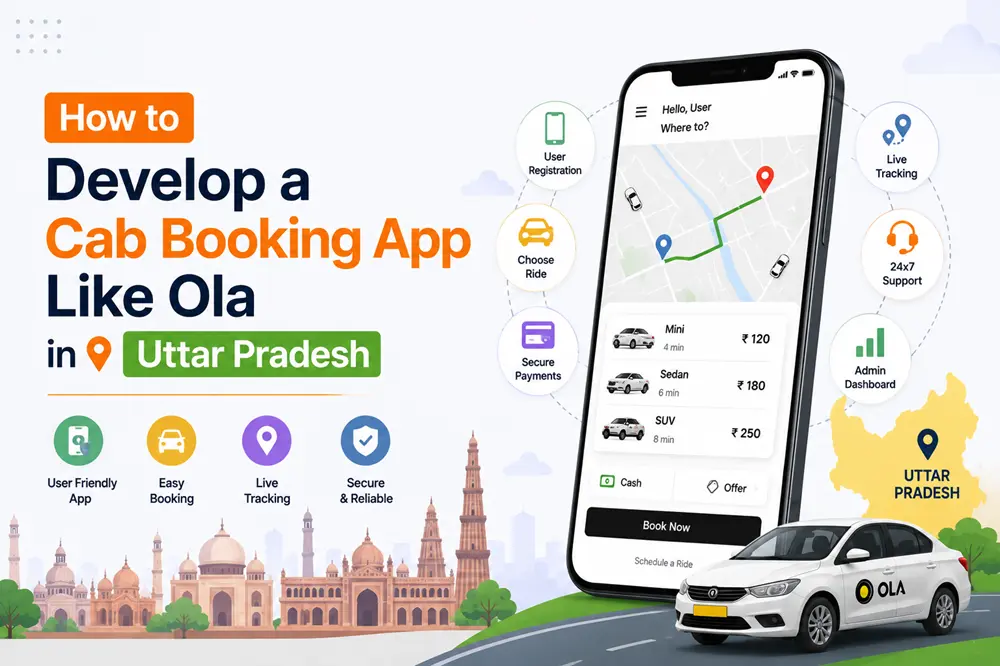
Uttar Pradesh has a large and diverse transportation market, covering major cities, industrial centers, tourist destinations, airports, railway hubs, and growing urban areas. This creates a strong opportunity for businesses that want to launch a digital cab-booking platform.
A cab booking app can connect passengers with drivers, automate ride allocation, support digital payments, provide live tracking, and help operators manage their fleet from a single platform. Businesses can also add AI-powered driver matching, demand forecasting, route optimization, and intelligent customer support to improve operations.
For companies planning this type of product, ola clone app development should not mean copying Ola's brand, interface, or proprietary technology. Instead, businesses can build an original ride-hailing platform based on similar core workflows and customize it for the Uttar Pradesh market.
Why Build a Cab Booking App in Uttar Pradesh in 2026?
India's taxi industry continues to grow as consumers adopt online booking and cashless payments. Mordor Intelligence estimates that the Indian taxi market will reach USD 23.98 billion in 2026 and projects it to reach USD 34.87 billion by 2031, representing a 7.78% CAGR. Online bookings accounted for 70.84% of the market in 2025.
The growth of tier-2 and tier-3 cities also creates opportunities outside India's largest metros. Uttar Pradesh has several large urban markets where customers need local commuting, airport transfers, railway station pickups, corporate transportation, tourism services, and intercity travel.
For example, Lucknow can serve as a central market for airport transfers, business travel, government-related travel, and daily commuting. A business can begin with Lucknow and gradually expand once it understands customer demand and driver supply.
The platform can then cover additional markets such as Kanpur, Agra, Varanasi, Prayagraj, Ghaziabad, Noida, Meerut, Bareilly, Aligarh, Moradabad, Saharanpur, Gorakhpur, Mathura, Ayodhya, Jhansi, and other growing cities.
Which Uttar Pradesh Cities Can a Cab App Target?
A successful state-wide strategy should not launch everywhere at once. Businesses should prioritize cities based on population, transportation demand, tourism, corporate activity, airport connectivity, and driver availability.
Lucknow is a natural starting point for many businesses. The city combines government offices, businesses, educational institutions, residential areas, railway connectivity, and Chaudhary Charan Singh International Airport. A platform can offer local rides, airport cabs, scheduled bookings, and corporate transportation.
Noida and Ghaziabad offer another strong opportunity because of their proximity to Delhi, business districts, IT companies, residential communities, and airport travel. A platform operating in this region can support both intra-city and NCR-oriented journeys.
Kanpur can support daily commuting, railway station transfers, corporate travel, and intercity rides. Agra can provide opportunities around tourism and airport or railway transfers, while Varanasi can support tourism, pilgrimage, airport transfers, and local transportation.
Businesses can later expand into Prayagraj, Meerut, Bareilly, Aligarh, Moradabad, Saharanpur, Gorakhpur, Mathura, Ayodhya, Jhansi, Firozabad, Muzaffarnagar, Rampur, Shahjahanpur, Hapur, Etawah, and Greater Noida.
Each location should have its own demand analysis. A tourism-focused service may work better in Agra, Varanasi, and Ayodhya, while corporate mobility may generate stronger demand in Noida, Greater Noida, Ghaziabad, Lucknow, and Kanpur.
What Features Should an Ola-Like Cab Booking App Have?
A modern cab platform normally requires three connected systems: a passenger application, a driver application, and an administration dashboard.
The passenger application should make booking quick. Users should enter their pickup and destination, select a vehicle category, view the estimated fare, confirm the trip, track the driver, make a payment, and receive a digital receipt.
The driver application should help drivers manage availability, accept or reject requests, navigate to pickup locations, update trip status, communicate with customers, and monitor earnings.
The admin dashboard should give operators control over customers, drivers, vehicles, bookings, payments, pricing, promotions, complaints, and analytics.
Additional features can include scheduled rides, real-time GPS tracking, estimated arrival times, UPI payments, ratings, reviews, SOS assistance, driver verification, referral programs, digital receipts, push notifications, and customer support.
The platform should also handle practical problems such as payment failures, driver cancellations, passenger cancellations, GPS inaccuracies, and duplicate booking attempts.
AI Features for a Smart Cab Booking App
Artificial intelligence can improve a ride-hailing platform when it solves measurable operational problems.
An AI-powered driver matching system can consider driver location, availability, vehicle category, traffic conditions, estimated arrival time, and previous acceptance patterns when allocating rides. This can help reduce passenger waiting time and improve driver utilization.
Predictive demand analytics can identify areas where booking requests may increase. The system can analyze historical trips, time of day, weekdays, holidays, weather conditions, airport traffic, railway schedules, and local events.
For example, a cab platform operating in Lucknow could analyze historical demand around the airport, railway stations, business districts, and residential areas to help drivers position themselves more effectively.
AI can also support route optimization, fraud detection, predictive fleet maintenance, personalized offers, AI customer support, voice-based booking, and demand forecasting.
Generative AI can power a conversational assistant that answers questions about fares, bookings, cancellations, payments, driver information, and lost items.
Businesses should introduce AI according to actual requirements rather than adding every trending feature.
Building an Ola Clone App for the Uttar Pradesh Market
Businesses interested in ola clone app development can create a ride-hailing platform with familiar capabilities such as location-based booking, driver matching, GPS tracking, digital payments, trip history, ratings, and notifications.
However, the application should have its own identity and business model. Companies should not copy Ola's trademarks, proprietary design, content, or technology.
A Uttar Pradesh-focused platform could differentiate itself through affordable intercity rides, scheduled bookings, airport transfers, corporate transportation, tourism packages, premium cabs, EV taxis, or specialized local services.
For example, a business could create dedicated services for Lucknow airport transfers or tourism-oriented transportation in Agra and Varanasi.
The same backend can later support markets such as Kanpur, Prayagraj, Meerut, Bareilly, Gorakhpur, Mathura, Ayodhya, and other cities.
Uber Similar App Development with a Custom Business Model
Uber similar app development allows businesses to build an independent ride-booking platform around established ride-hailing workflows.
The business can define its own commission structure, pricing rules, driver incentives, vehicle categories, service zones, cancellation policies, loyalty programs, and corporate packages.
This flexibility is useful when entering a market such as Uttar Pradesh because customer expectations can differ between cities.
For instance, a platform may emphasize corporate rides in Noida and Ghaziabad, tourism services in Agra and Varanasi, and airport or intercity bookings in Lucknow.
A scalable backend should allow businesses to add new service areas without rebuilding the entire platform.
How to Develop a Cab Booking App Step by Step
The first stage involves business and market research. The team should identify target cities, customer groups, vehicle categories, driver acquisition strategies, pricing models, revenue streams, and competitors.
The next stage defines the product requirements and technical architecture. This includes passenger and driver applications, admin panels, booking engines, APIs, databases, payment systems, mapping services, notifications, analytics, and security controls.
The UI/UX team then designs the main booking journey. The passenger should be able to complete a booking without unnecessary screens or confusing options.
Developers build the mobile applications and backend after the product design receives approval. APIs connect the platform with payment gateways, maps, notifications, authentication systems, and other services.
The team then tests booking allocation, GPS tracking, payment processing, authentication, notifications, security, and performance.
After launch, businesses should monitor actual customer and driver behavior. Booking conversion, cancellation rates, average waiting time, driver acceptance, customer ratings, repeat bookings, and failed payments can provide useful data for future improvements.
This continuous process helps the platform adapt to real market conditions.
Taxi Booking Website and Web Dashboard Development
A cab business should not depend entirely on mobile applications. A responsive website can support customers, corporate clients, drivers, and internal teams.
A taxi booking website creation company can build a website where customers can view services, calculate estimated fares, schedule rides, manage bookings, and contact support.
Corporate customers can receive dedicated accounts for employee transportation, invoices, ride management, and travel reporting.
The web administration system can manage drivers, customers, bookings, vehicles, payments, promotions, pricing, complaints, and analytics.
The website can also support local SEO by providing genuinely useful pages for services in Lucknow, Noida, Kanpur, Agra, Varanasi, Prayagraj, and other cities. Each page should offer unique information rather than simply repeating city names.
Cost to Develop a Cab Booking App Like Ola
The development cost depends on the number of platforms, features, integrations, AI capabilities, design requirements, security, and expected scale.
|
Development Level |
Typical Scope |
Estimated Cost |
|
Basic MVP |
Passenger App, Driver App, Booking, GPS, Payment, Admin |
₹7–10 Lakhs |
|
Standard Platform |
MVP + Scheduling, Ratings, Coupons, Notifications, Analytics |
₹10–25 Lakhs |
|
AI-Powered Platform |
AI Matching, Demand Forecasting, Route Optimization, AI Support |
₹25–50 Lakhs |
|
Enterprise Platform |
Multi-City, Corporate Booking, Fleet Management, Advanced AI |
₹50 Lakhs + |
These figures are indicative and can change based on the final scope. Businesses should also consider ongoing costs for cloud hosting, map APIs, payment processing, security monitoring, maintenance, AI services, and customer support.
Starting with an MVP in one or two cities can reduce initial investment. Once the business validates demand, it can add more cities and advanced features.
How to Choose the Right Cab App Development Company
Choosing the right technology partner requires more than checking whether a company can build a mobile application.
Businesses should evaluate experience with real-time GPS tracking, payment integration, scalable backend systems, cloud infrastructure, driver management, analytics, cybersecurity, and AI.
When hiring taxi booking app development company, businesses should ask how the team handles payment failures, duplicate bookings, GPS inaccuracies, driver cancellations, high traffic, and system downtime.
The company should also understand the target market. A platform designed for Lucknow may require different service priorities from one targeting Noida, Agra, or Varanasi.
Post-launch support matters as well. Taxi platforms require regular updates for operating systems, third-party APIs, security, payment systems, maps, and new customer requirements.
Why Choose Dinoustech for Cab Booking App Development?
Dinoustech is one of the software and web development companies that helps businesses build custom mobile applications, websites, and business software.
For a cab booking platform, the development scope can include passenger and driver applications, admin dashboards, booking systems, GPS tracking, payment integration, analytics, APIs, and AI-powered functionality.
A business can launch its initial service in Lucknow, Noida, Kanpur, Agra, or another selected market and expand as its driver network and customer base grow.
AI capabilities can be introduced where they provide measurable value, including intelligent driver allocation, demand prediction, route optimization, fraud monitoring, automated support, and business analytics.
The focus should remain on real users. Passengers need simple booking, drivers need efficient trip management, and operators need reliable data and control.
Future Trends in Cab Booking App Development
The cab industry is moving toward more intelligent and connected mobility platforms. Generative AI, agentic AI, predictive analytics, AI dispatch, EV fleet management, real-time route optimization, conversational booking, digital payments, and personalized mobility services are important technology trends for modern ride-hailing platforms.
Mordor Intelligence estimates that AI-based mobility-as-a-service integrations are becoming a growth factor in the Indian taxi market, while electric taxis are also expected to grow faster than conventional propulsion through 2031.
Businesses can use these trends to build better operations. An EV-focused platform, for example, could add charging-station information and battery-aware trip planning. An AI-focused platform could use demand prediction to improve driver positioning.
The key is to test new technology against business KPIs instead of adding features only because they are trending.
Conclusion
Developing a ta booking app like Ola in Uttar Pradesh can provide businesses with an opportunity to enter a growing digital mobility market. India's taxi market is estimated at USD 23.98 billion in 2026 and is projected to reach USD 34.87 billion by 2031, according to Mordor Intelligence.
The opportunity extends beyond Lucknow. Noida, Ghaziabad, Kanpur, Agra, Varanasi, Prayagraj, Meerut, Bareilly, Aligarh, Moradabad, Saharanpur, Gorakhpur, Mathura, Ayodhya, Jhansi, and other cities can support different mobility use cases.
The strongest platform will not simply copy Ola or Uber. It will solve specific local transportation problems through reliable booking, transparent pricing, secure payments, strong driver management, and a simple user experience.
Businesses can start with an MVP, collect real customer and driver data, and gradually add AI-powered mobility features, predictive analytics, intelligent dispatch, EV support, and personalized services.
With the right product strategy and experienced taxi booking app developers, a business can build a scalable cab-booking platform designed specifically for the Uttar Pradesh market.