Dinoustech Private Limited
Build Your Own Payment App Like CRED in 2026
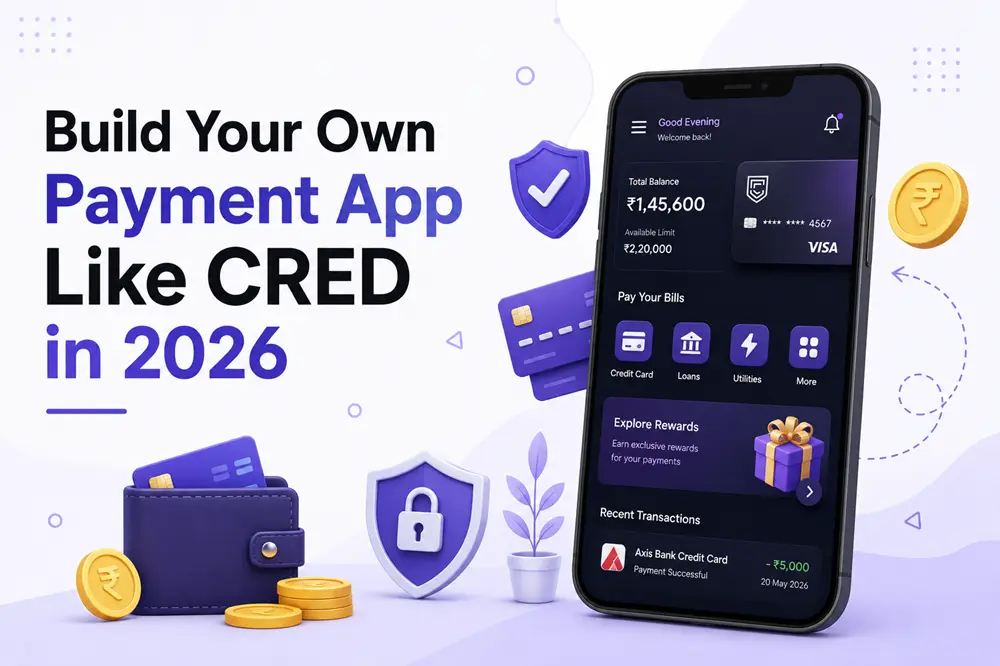
Digital payments have become a core part of everyday commerce in India. Users now expect fast transactions, clear payment records, rewards, personalized offers, and strong security from financial applications. This creates an opportunity for businesses that want to build their own payment platform with features inspired by successful products such as CRED.
A modern payment application can go beyond basic money transfers. Businesses can combine UPI payments, credit card bill payments, rewards, financial insights, expense tracking, loyalty programs, AI-powered recommendations, and personalized experiences in one platform.
The opportunity is supported by the scale of India's digital payment ecosystem. According to the Reserve Bank of India, India's digital payments volume increased significantly in recent years, with UPI becoming one of the country's most widely used digital payment methods. RBI's Digital Payments Index also reached 493.22 for March 2025, compared with 100 in March 2018, showing the rapid growth of digital payment adoption.
For businesses planning a new product, payment app development like CRED requires more than creating attractive screens. The platform needs secure payment infrastructure, reliable APIs, strong authentication, scalable backend systems, fraud controls, and a clear business model.
What Makes a Payment App Like CRED Different?
CRED built its product around credit-card payments, rewards, financial management, and a premium user experience. Businesses can use this concept as a starting point while creating an independent product with its own features and market positioning.
A new payment app could focus on credit-card bill payments, UPI transactions, bill management, rewards, cashback, expense tracking, credit insights, or merchant offers. The exact combination should depend on the target audience.
For example, a platform targeting young professionals could combine payment management with rewards and spending insights. A business-focused product could focus on corporate expenses, invoice payments, employee cards, and financial reporting.
The important point is to build a product around a specific customer problem rather than simply copying an existing application.
Also Read: - AI Features Every FinTech App Should Have in 2026
Payment App Market Opportunity in 2026
India provides a large market for businesses entering digital financial services. RBI data shows that UPI processed billions of transactions each month, while digital payment adoption continues to expand across consumers and businesses.
The global digital payments market is also expanding as consumers increasingly use mobile wallets, account-to-account payments, cards, and embedded payment services.
This creates opportunities for startups, fintech companies, banks, NBFCs, retailers, and technology businesses to develop specialized payment platforms.
However, competition is also high. A successful application needs a clear value proposition. Cashback alone may not create long-term loyalty. Businesses can combine rewards with financial insights, personalized experiences, better payment management, merchant benefits, and AI-powered services.
Core Features for Payment App Development
A successful payment platform needs a secure and convenient user experience. Users should be able to register, verify their identity, connect eligible payment methods, make transactions, view payment history, manage bills, and receive notifications.
A payment application can include UPI payments, credit-card bill payments, bank-account integration, utility bill payments, merchant payments, rewards, cashback, transaction categorization, expense tracking, referral programs, and personalized offers.
The application should also provide a reliable notification system. Users need instant updates for successful transactions, failed payments, refunds, rewards, bill reminders, and other important account activity.
An administration panel should allow authorized teams to monitor users, transactions, rewards, disputes, campaigns, merchants, reports, and system activity.
Businesses should also consider features such as AI financial assistants, intelligent expense categorization, fraud detection, personalized rewards, predictive payment reminders, conversational banking, and automated customer support.
These features can help the product stay relevant as users increasingly expect intelligent financial services.
Must Read: - Create a Fintech App Like Wise for Global Transactions
UPI, Cards, Banks, and Payment Gateway Integration
Payment applications depend heavily on external financial infrastructure. A business needs to determine which payment methods it will support and how those integrations will work.
UPI can support account-to-account transactions, while card integrations can support credit and debit card payments. Bank APIs can provide approved account and financial information, subject to applicable permissions and regulations.
Payment gateways can simplify merchant payment processing, while specialized APIs can support bill payments, verification, notifications, and other financial services.
The technical architecture should handle API failures and transaction reconciliation properly. A payment should not remain in an uncertain state simply because an external service temporarily fails.
An experienced fintech software development company can help design an architecture that manages payment requests, callbacks, transaction status, reconciliation, and error handling.
AI Features for a Smarter Payment App
Artificial intelligence can add useful capabilities to a payment application when businesses apply it to real user needs.
An AI financial assistant can help users understand spending patterns, upcoming bills, recurring expenses, and payment activity. Users could ask questions in natural language and receive responses based on permitted financial information.
AI can also categorize transactions automatically. Instead of manually sorting every expense, the system can classify transactions into categories such as food, shopping, travel, utilities, subscriptions, and entertainment.
Another important use case is AI-powered fraud detection. Machine learning systems can identify unusual transaction behavior and flag activity for additional review.
Businesses can also use AI for personalized rewards. The application could analyze permitted transaction patterns and recommend relevant offers, rewards, or financial tools.
Other trending fintech technologies include Generative AI, agentic AI, AI-powered customer support, predictive analytics, intelligent automation, conversational payments, and personalized financial recommendations.
AI should support financial decisions rather than make high-impact decisions without appropriate controls.
Security and Compliance Requirements
Security is one of the most important parts of payment app development. Financial applications handle sensitive information, so businesses must build security into the architecture from the beginning.
Strong authentication, encryption, secure APIs, device verification, access controls, transaction monitoring, fraud detection, audit logs, and secure data storage all play important roles.
Businesses operating in India also need to consider applicable RBI requirements, NPCI ecosystem rules, payment regulations, data protection requirements, KYC obligations, and other legal requirements relevant to their business model.
The exact compliance requirements depend on what the application actually does. A loyalty application connected to an external payment provider may have different requirements from a business that directly provides regulated payment services.
A qualified legal and compliance team should review the business model before development and launch.
Also Read: - How to Create a Digital Wallet App Like Google Pay & Paytm
How to Build a Payment App Like CRED
The development process should start with product research. Businesses should define the target audience, payment services, revenue model, reward strategy, competitive advantage, and regulatory requirements.
The next stage involves creating the product architecture. This includes the mobile application, backend, database, APIs, payment integrations, notification services, admin panel, analytics, security systems, and AI components.
The UI/UX team should focus on simple financial workflows. Users should quickly understand their payment status, available rewards, upcoming bills, transaction history, and account information.
Developers then build the application and integrate the required payment and financial services.
Testing should cover authentication, payment processing, refunds, transaction status, API failures, security, notifications, device compatibility, and high-volume transaction scenarios.
After launch, the business should monitor user behavior and continuously improve the application based on measurable results.
This approach helps the product evolve around actual customer needs instead of assumptions.
Payment App Development Cost in 2026
The cost depends on features, platforms, integrations, security requirements, AI capabilities, design complexity, and development team.
|
Development Level |
Approximate Scope |
Estimated Cost |
|
Basic Payment MVP |
User App, Payments, Transaction History, Admin Panel |
₹7–10 Lakhs |
|
Standard Fintech App |
UPI/Card Integration, Bills, Rewards, Notifications, Analytics |
₹10–25 Lakhs |
|
AI-Powered Payment App |
Standard Features + AI Assistant, Fraud Detection, Personalization |
₹25–50 Lakhs |
|
Enterprise Platform |
Advanced Fintech Infrastructure, Multi-Service Ecosystem, AI, Analytics |
₹50 Lakhs + |
These figures provide an indicative planning range. The actual cost can vary significantly depending on the business model and integrations.
Businesses should also plan for cloud infrastructure, third-party APIs, payment processing, security monitoring, compliance, maintenance, customer support, and future development.
Launching an MVP first can help reduce initial investment and allow the business to validate its concept before adding advanced features.
How to Monetize a Payment App
A payment application can generate revenue through multiple channels.
Businesses can earn through merchant commissions, subscription plans, premium financial services, partner offers, referral commissions, transaction-related services, and carefully designed financial products.
A rewards-based model can also create partnerships with brands and merchants. Users receive relevant offers while businesses gain access to a targeted customer base.
Subscription models can provide premium features such as advanced financial analytics, higher reward limits, exclusive offers, automated expense management, or personalized financial tools.
The revenue model should remain transparent. Users should understand what they receive and what they pay for.
How to Choose the Right Fintech Development Partner
Choosing the right development partner is important because payment platforms require expertise beyond standard mobile development.
Businesses should evaluate experience with fintech applications, payment APIs, UPI-related integrations, banking APIs, cloud infrastructure, cybersecurity, data protection, AI, and scalable backend systems.
When hiring fintech app developers, businesses should ask how the team handles transaction failures, reconciliation, API downtime, security incidents, authentication, and sensitive financial data.
The development partner should also understand the importance of user experience. A secure application that users find difficult to operate will struggle to gain adoption.
Businesses looking for a fintech website creation company should also check whether the team can build responsive customer portals, payment dashboards, merchant panels, financial reports, and secure web applications alongside mobile products.
Why Choose Dinoustech for Payment App Development?
Dinoustech is one of the software and web development companies that helps businesses build custom fintech applications, payment platforms, websites, and business software.
For a payment product, the development scope can include user applications, admin dashboards, payment integrations, financial APIs, transaction management, rewards systems, analytics, and AI-powered features.
Businesses can use AI for financial assistance, automated transaction categorization, fraud monitoring, customer support, personalized offers, and predictive insights based on approved data.
The development strategy should focus on security, scalability, compliance requirements, and real customer needs. Instead of adding every available fintech feature, the product should prioritize capabilities that directly support the business model.
Future Trends in Payment App Development
Payment applications are moving toward more intelligent and personalized financial experiences. Generative AI, agentic AI, embedded finance, open banking, biometric authentication, real-time payments, digital wallets, predictive analytics, and conversational banking are likely to remain important areas for fintech businesses.
AI assistants may become more deeply integrated into financial applications, allowing users to manage payments, understand expenses, receive reminders, and access financial information through conversational interfaces.
Payment platforms may also increasingly combine multiple financial services within a single application. This can include payments, rewards, credit management, expense tracking, insurance, investments, and personalized financial tools.
Businesses should monitor these trends but adopt them based on customer demand and measurable business value.
Conclusion
Building a payment application like CRED in 2026 requires a combination of fintech expertise, secure payment infrastructure, strong UX, reliable APIs, AI capabilities, and a clear business strategy.
Payment app development like CRED should not mean copying another company's product. Instead, businesses can study successful payment models and build an original platform around their own target audience and value proposition.
The most important priorities are secure transactions, simple user experiences, reliable payment processing, useful rewards, strong fraud controls, and responsible use of AI.
With an experienced fintech software development company and capable fintech app developers, businesses can start with a focused MVP and gradually expand into a broader financial ecosystem.
The strongest products will continuously use customer feedback, transaction data, market trends, and new technology to improve the experience while maintaining security and regulatory discipline.