Dinoustech Private Limited
AI-Based Property Recommendations for Real Estate Platforms
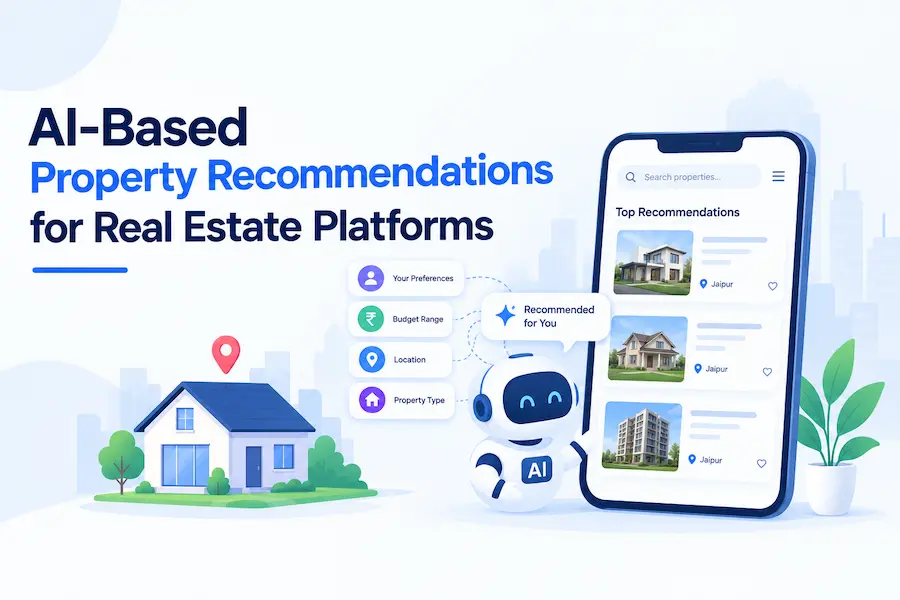
Finding the right property can take a lot of time. Buyers and renters often browse hundreds of listings, compare prices, check locations, review amenities, and contact multiple agents before making a decision. Traditional property portals mainly depend on search filters such as location, budget, property type, number of bedrooms, and size. These filters are useful, but they do not always understand what a user actually wants.
Artificial intelligence is changing this experience. AI-based property recommendation systems can analyze user preferences, search behavior, property characteristics, location data, and previous interactions to suggest listings that are more relevant to each user. Instead of making users search through large databases manually, an AI-powered real estate platform can bring suitable properties directly to them.
This shift is creating new opportunities for businesses investing in real estate app development. A modern real estate application can combine AI, machine learning, location services, property databases, recommendation engines, chatbots, virtual tours, and analytics to create a more personalized property discovery experience.
What Is an AI-Based Property Recommendation System?
An AI-based property recommendation system is a technology that uses artificial intelligence and machine learning to suggest properties to users based on their preferences and behavior. The system can analyze information such as preferred location, budget, property type, size, amenities, previous searches, saved listings, viewed properties, and interaction history.
For example, a buyer may initially search for a three-bedroom apartment in a particular area within a specific budget. After viewing several listings, the system can identify patterns in the user's activity. If the buyer repeatedly opens properties with parking, balconies, and proximity to schools, the recommendation engine can give greater importance to these factors.
The system can continue improving its recommendations as users interact with more properties. This makes AI-powered real estate app development different from a basic property listing application because the platform becomes more responsive to individual preferences.
For businesses, this technology can also improve property discovery, engagement, lead generation, and the overall experience for buyers, renters, agents, brokers, and property developers.
Why AI Matters in Real Estate App Development
Real estate platforms often contain thousands or even millions of property listings. Giving users access to a large inventory is valuable, but too many choices can also make the search process difficult.
AI can help organize this information around individual user requirements. Instead of showing the same properties to everyone searching for an apartment in a particular location, an intelligent recommendation engine can prioritize listings based on each user's preferences and behavior.
AI can also help real estate businesses understand their customers. Platforms can analyze which properties users view, save, share, compare, or ignore. These insights can support better recommendations and more targeted communication.
For real estate businesses, this can make real estate app development more than a digital listing solution. The application can become an intelligent platform that connects property inventory with users based on their requirements.
Also Read: - Develop a Real Estate App Like MagicBricks for Property Listings
How AI Property Recommendations Work
An AI recommendation engine generally works through several stages. First, the platform collects relevant property and user information. Property information may include price, location, property type, size, bedrooms, bathrooms, amenities, construction status, and other listing attributes.
The system can then analyze user behavior. Searches, clicks, saved properties, viewed listings, inquiries, and other interactions can provide signals about user preferences.
Machine learning algorithms can process these signals and calculate how closely different properties match the user's requirements. The platform can then rank or recommend relevant listings.
As more users interact with the platform, the system can learn from additional data. A mature recommendation engine may combine several approaches, including content-based recommendations, collaborative filtering, behavioral analysis, location intelligence, and machine learning models.
The exact architecture depends on the scale and requirements of the platform. A small property marketplace may start with rule-based recommendations and gradually introduce more advanced machine learning capabilities.
Key AI Features for Real Estate Platforms
Personalized Property Recommendations
Personalized property recommendations are the core feature of an AI-driven real estate platform. The system can use user preferences and behavior to display listings that match individual requirements.
For example, two users may search for properties in the same city but have very different priorities. One may prioritize a low price and public transportation, while another may focus on premium amenities and larger living spaces.
An intelligent recommendation engine can account for these differences instead of providing identical results to both users. This makes property search app development more personalized and can reduce the amount of manual searching required.
AI-Powered Property Search
Traditional real estate applications usually require users to select multiple filters. AI can make search more conversational and flexible.
A user could enter a request such as, "Show me a two-bedroom apartment near a metro station with parking under my budget." An AI-powered search system can identify the important requirements and convert them into structured search parameters.
Natural language processing can make the search interface easier for users who do not want to work with multiple filter menus. This can be particularly useful in mobile applications where screen space is limited.
Smart Property Matching
AI can calculate a matching score between a user's requirements and available properties. Instead of treating every search condition equally, the system can learn which factors appear to matter most to a particular user.
For example, if a user consistently rejects properties without parking, the system can give parking greater importance in future recommendations. Similarly, if the user frequently chooses properties near a particular type of location, proximity can become a stronger recommendation signal.
Smart matching can help buyers and renters reach relevant listings faster while helping agents promote properties to users who may have a stronger interest.
AI-Based Price Recommendations
Pricing is one of the most important factors in real estate decisions. AI can analyze historical listing data, location trends, property characteristics, and other available market information to generate estimated price insights.
For example, an application could compare similar properties in the same locality and provide an estimated price range. This information can help users understand whether a listing falls within the typical range for similar properties.
For agents and property owners, AI-based pricing tools can support data-driven listing decisions. However, price estimates should be presented as estimates rather than guaranteed property valuations because real estate pricing depends on many factors that may not be represented in the available dataset.
Location-Based Recommendations
Location plays a major role in property decisions. Buyers may care about schools, offices, hospitals, shopping centers, transportation, entertainment, or other nearby facilities.
A real estate application can use maps and location services to analyze these preferences. AI can then recommend properties based not only on the property's address but also on the user's preferred surroundings.
For example, a family searching for a home may prioritize proximity to schools and hospitals, while a professional may care more about commuting distance to an office.
This makes location intelligence an important part of modern real estate mobile app development.
AI Chatbots for Real Estate
AI chatbots can help users interact with real estate platforms through natural conversations. Instead of navigating multiple pages, users can ask questions about available properties, prices, amenities, locations, and other listing information.
A chatbot can also help qualify leads. It can ask users about their budget, preferred location, property type, and timeline before presenting suitable listings to them.
For real estate agencies, this can reduce repetitive communication and provide initial assistance outside regular working hours.
However, the chatbot should use reliable property data from the platform rather than generating unsupported information. Its responses should be connected to the application's database and approved business content.
AI Lead Qualification
Real estate businesses receive leads from multiple sources, but not every lead has the same level of intent. AI can help classify leads based on available interactions and information.
For example, a person who repeatedly views properties, saves listings, asks questions, and requests a callback may show stronger engagement than someone who only visits one listing.
AI can help agents organize these leads and prioritize follow-up based on predefined business rules and engagement signals. This can improve sales workflow without requiring agents to manually review every interaction.
AI-Based Property Description Generation
Real estate businesses manage large numbers of property listings. Creating descriptions manually can take significant time, particularly for agencies managing hundreds of properties.
Generative AI can assist agents in creating initial property descriptions from structured information such as location, property type, size, amenities, and nearby facilities.
Agents should review AI-generated descriptions before publishing them to ensure that the content accurately represents the property. AI should not invent features, facilities, measurements, or claims that are not supported by the actual listing data.
AI Image and Listing Analysis
Computer vision can also support real estate applications. AI can analyze property images to identify certain visible characteristics and organize image-based information.
For example, an application could help categorize images into bedrooms, kitchens, bathrooms, living rooms, or outdoor areas. This can make large property databases easier to manage.
Computer vision can also support quality checks, although businesses should validate AI-generated classifications before using them in important workflows.
Virtual Tours and AI-Assisted Property Discovery
Virtual tours allow users to view properties remotely. When combined with AI, these experiences can become more interactive.
An application could guide users through available rooms, provide property information, highlight selected features, or recommend similar properties based on what the user views during a virtual experience.
This can be particularly useful for buyers and renters who are searching from another city or country.
Also Read: - How a Real Estate App Can Help Agents Close More Deals
Benefits of AI Property Recommendations
The main benefit of AI recommendations is that they can reduce the amount of manual effort required during property discovery. Users can receive listings that better match their requirements rather than browsing every available property.
For real estate companies, personalized recommendations can increase engagement with listings. When users see properties that are more relevant to their interests, they may spend more time on the platform and interact with more listings.
AI can also help agents understand customer preferences. Instead of relying entirely on conversations or manual notes, agents can use platform-generated insights to understand what properties a lead has interacted with.
For property developers and listing platforms, recommendation technology can create new opportunities for personalized marketing and lead generation.
AI Technology Stack for Real Estate App Development
An AI-powered real estate application usually combines several technologies. The mobile application can be developed using native technologies such as Swift and Kotlin or cross-platform frameworks such as Flutter and React Native.
The backend can use technologies such as Node.js, Python, Java, or similar frameworks depending on the project's requirements. Python is commonly useful for AI and machine learning workflows because of its extensive ecosystem.
Machine learning models can support property recommendations, user segmentation, pricing analysis, and predictive analytics. Natural language processing can support conversational search and AI chatbots.
Maps and location services can be integrated for property discovery, distance calculations, neighborhood information, and map-based searches. Cloud infrastructure can support databases, APIs, media storage, analytics, and scalable application services.
The technology stack should be selected according to the application's expected users, property inventory, AI requirements, integrations, and future growth rather than simply following technology trends.
Must Read: - Building a Property Rental App Like Airbnb: What You Need to Know
How to Build an AI-Powered Real Estate App
The first step is to define the target market and business model. A platform for property buyers may require different functionality from a rental marketplace, commercial property platform, property management application, or real estate agency app.
Next, the business should define its property data structure. Accurate and consistent property information is essential because recommendation quality depends heavily on the data available to the system.
The development team can then create the core application, including user registration, property listings, search, filters, maps, favorites, property details, inquiries, notifications, and agent profiles.
After the basic platform is functional, AI capabilities can be integrated. Businesses can begin with personalized recommendations and gradually add conversational search, lead scoring, pricing insights, AI chatbots, and predictive analytics.
Testing should cover both the application and AI functionality. Developers need to check recommendation relevance, search accuracy, chatbot responses, data consistency, performance, security, and integration reliability.
How Much Does Real Estate App Development Cost?
The cost of real estate app development depends on the type of application, number of platforms, features, design complexity, integrations, AI requirements, and development team.
A basic real estate listing application with user registration, property listings, search, filters, favorites, and an admin panel may cost approximately 20,000–40,000.
A mid-level real estate marketplace with maps, agent profiles, inquiries, notifications, advanced search, property comparisons, and subscription functionality may cost around 40,000–80,000.
An AI-powered real estate platform with personalized recommendations, AI search, chatbots, lead scoring, pricing analytics, and advanced property matching may cost approximately 80,000–180,000+.
Enterprise platforms with large property databases, advanced machine learning, multiple user roles, third-party integrations, virtual tours, complex analytics, and scalable cloud infrastructure can exceed $180,000.
These figures are general planning ranges, not fixed development quotes. A professional real estate app development company should provide a detailed estimate after reviewing the required features, target platforms, AI functionality, integrations, and project scope.
Monetization Models for Real Estate Apps
Real estate platforms can generate revenue through several business models. Listing fees are one option, where agents, brokers, developers, or property owners pay to publish properties.
Featured listings can provide another revenue stream. Agents can pay to promote selected properties so they receive additional visibility within the platform.
Subscription plans can offer premium tools for agents and businesses, such as advanced analytics, lead management, additional listings, CRM features, or enhanced property promotion.
Real estate marketplaces can also generate revenue through lead-generation packages, advertising, transaction fees, premium property reports, or partnerships with related service providers.
The appropriate monetization strategy depends on the target market and the type of real estate platform being developed.
Must Read: - Build a Property Management App: Simplify Rentals & Tenant Experience
Security and Data Privacy in Real Estate Apps
Real estate applications handle valuable information, including user profiles, contact details, property data, communication records, and potentially financial information. Security should therefore be considered from the beginning of the development process.
Applications should use secure authentication, encrypted communication, appropriate access controls, secure database practices, and protected APIs. Administrative users should receive permissions based on their roles.
AI systems also require careful data management. Businesses should understand what information is being collected, how it is stored, how it is used for recommendations, and which third-party AI services receive data.
Clear privacy policies and appropriate user consent mechanisms should be implemented according to the markets in which the application operates.
Why Businesses Should Invest in AI-Based Property Recommendations
Real estate platforms compete heavily on user experience and property inventory. Having a large database of listings is useful, but helping users find relevant properties quickly can become an important differentiator.
AI recommendations allow businesses to move from basic search toward personalized property discovery. Instead of simply matching keywords and filters, the platform can learn from user interactions and improve its recommendations over time.
AI can also benefit the business side of the platform. Lead qualification, customer segmentation, listing recommendations, pricing analysis, and automated support can reduce repetitive work and provide agents with more useful information.
For companies planning real estate app development, AI can therefore be introduced as a practical layer across search, recommendations, engagement, and business operations.
Choosing a Real Estate App Development Company
The development partner can have a major impact on the quality and scalability of the final application. Businesses should look for a real estate app development company that understands both real estate workflows and modern mobile technology.
The company should have experience with property listings, map integrations, search systems, user roles, agent dashboards, payment systems where required, cloud infrastructure, and AI integrations.
It is also important to ask how the development team plans to build the recommendation engine. A reliable approach should start with clean property data and clearly defined user requirements before selecting machine learning techniques.
Businesses should also consider post-launch support. AI models, APIs, operating systems, security requirements, and third-party integrations may require regular updates.
Future of AI in Real Estate Platforms
The role of AI in real estate is likely to expand as property platforms collect more structured data and users become more comfortable with personalized digital experiences.
Future real estate applications may combine conversational property search, AI agents, predictive analytics, computer vision, virtual tours, location intelligence, and personalized recommendations within one platform.
Users may be able to describe their ideal property in natural language and receive a curated selection based on their preferences. AI systems could also help agents summarize customer requirements, prepare property comparisons, organize leads, and recommend follow-up actions.
However, businesses should focus on useful implementation rather than adding AI simply for marketing purposes. The strongest applications will use AI to solve clear problems such as improving property discovery, reducing search time, supporting agents, and making large property inventories easier to navigate.
Conclusion
AI-based property recommendations are changing how real estate platforms connect users with properties. Instead of relying entirely on traditional filters, businesses can use artificial intelligence to understand preferences, analyze user behavior, personalize property searches, and recommend listings that are more relevant to individual users.
For businesses investing in real estate app development, AI can support much more than property recommendations. Conversational search, smart property matching, price insights, AI chatbots, lead qualification, computer vision, virtual tours, and predictive analytics can all become part of a modern real estate platform.
The key is to build these capabilities around real user and business requirements. A well-designed AI-powered real estate application can combine a strong property database with intelligent recommendations and a simple user experience, helping buyers, renters, agents, brokers, and developers interact with property information more efficiently.