Dinoustech Private Limited
Key Features of a Modern Astrology Consultation App
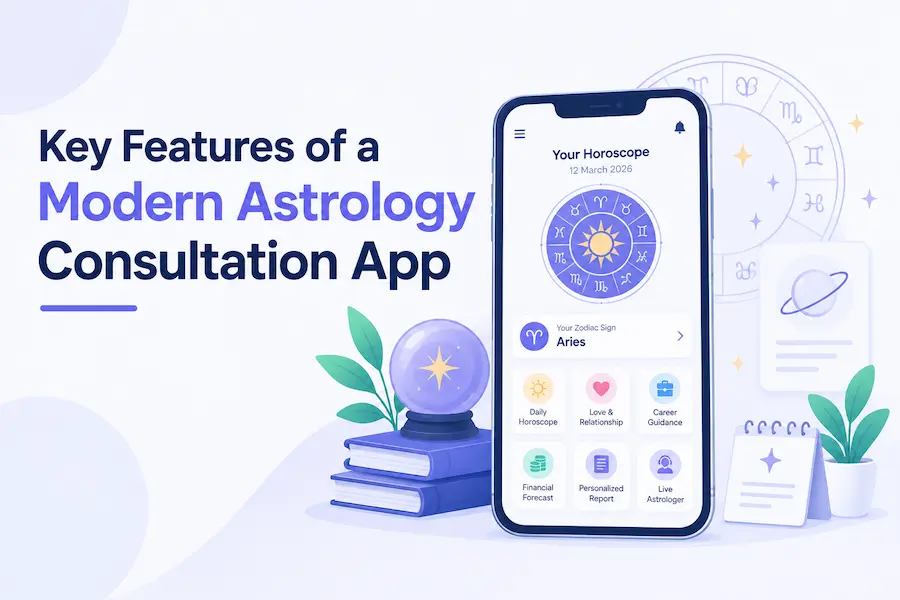
Astrology consultation has moved from offline appointments to mobile platforms where users can connect with astrologers, generate birth charts, receive horoscope updates, and access personalized guidance from anywhere. A modern astrology consultation app can bring these services together in one place while making the experience faster and easier for both users and astrologers.
The market is also creating room for new digital astrology businesses. According to The Business Research Company, the global astrology app market is estimated at $5.69 billion in 2026 and is projected to reach $11.71 billion by 2030, growing at a CAGR of 19.8%. The report identifies AI-driven solutions, personalised horoscope generation, real-time insights, subscription models, and interactive astrology features as important market trends.
AI is adding another layer to the consultation experience. Modern platforms can use AI for birth-chart interpretation, personalised recommendations, conversational astrology assistants, profile analysis, multilingual content, and automated customer support. At the same time, live astrologer consultations remain important for users who want direct human interaction.
This guide covers the key features, AI capabilities, development process, cost, monetisation options, and technology considerations for building a modern astrology consultation app.
What Is an Astrology Consultation App?
An astrology consultation app is a mobile or web platform that connects users with astrology services and professional astrologers. Users can create profiles, enter their birth details, generate Kundli or birth charts, view horoscopes, book consultations, and communicate with astrologers through chat or calls.
A modern platform can support several astrology categories, including Vedic astrology, Western astrology, numerology, tarot, Kundli matching, Panchang, compatibility analysis, and personalised horoscope reports.
The platform normally includes three main user groups: customers, astrologers, and administrators. Customers use the app to find services and consultations. Astrologers manage profiles, availability, consultations, earnings, and customer interactions. Administrators control users, astrologer verification, payments, content, reports, commissions, and platform settings.
The goal should not be to add every possible feature from day one. A better approach is to build the core consultation experience first and then add AI, automation, analytics, and advanced services based on actual user behaviour.
Also Read: - How to Create an Astrology App Like AstroSage?
Why Invest in Astrology Consultation App Development?
A dedicated consultation app can help astrology businesses reach customers beyond a physical location. Users can access services through smartphones, while astrologers can manage consultations without relying completely on manual bookings.
India is an important market for this type of platform. MarkNtel Advisors estimates that India's astrology app market was worth $270 million in 2025, is projected to reach $390 million in 2026, and could reach $2.32 billion by 2032, representing a projected CAGR of 34.61% during 2026–2032. The report also identifies Vedic astrology, transaction-based monetisation, AI astrologers, regional-language services, and personalised recommendations as notable areas of opportunity.
The Google Play listing for AstroTalk, for example, currently shows 10 crore+ downloads and describes services including live astrologer chat and calls, Kundli, matchmaking, horoscopes, tarot, numerology, Vastu, and other astrology services. This illustrates the range of functionality users may expect from a large consultation platform.
For a new business, the opportunity can come from building a focused platform for a specific audience, language, region, astrology category, or consultation model.
What Are the Must-Have Features of an Astrology Consultation App?
User Registration and Astrology Profile
The registration process should remain simple. Users can sign up through email, phone number, social login, or other supported authentication methods.
The astrology profile should allow users to save their name, date of birth, time of birth, place of birth, preferred language, consultation interests, and other information required by the platform.
Users should be able to create multiple profiles where appropriate, such as profiles for themselves, partners, children, or family members. This can make Kundli matching and family-oriented services easier to manage.
Astrologer Profiles and Search
Users should be able to browse astrologers based on expertise, language, experience, consultation price, availability, ratings, and consultation format.
An astrologer profile can display areas of expertise such as Vedic astrology, tarot, numerology, marriage consultation, career astrology, or relationship consultation.
Search and filtering should help users find a suitable consultant without forcing them to scroll through hundreds of profiles.
Chat, Voice, and Video Consultation
Real-time communication is one of the most important features of an astrology consultation app.
The platform can support text chat, voice calls, and video consultations. Users should see an astrologer's availability before booking or starting a consultation.
A consultation timer can help manage pay-per-minute services, while a wallet or prepaid balance can simplify transactions.
The app should also maintain appropriate records of consultation transactions and provide clear pricing before a user starts a paid session.
How Can AI Improve an Astrology Consultation App?
AI can make an astrology app more interactive by automating certain tasks and personalising content.
An AI astrology assistant can answer general astrology-related questions, explain chart elements, generate horoscope content, and provide conversational experiences based on information supplied by the user.
AI-powered birth-chart analysis can interpret structured chart data and generate explanations in a simpler format. The platform can also provide personalised daily, weekly, or monthly horoscope content.
A recommendation engine can suggest relevant astrologers based on the user's selected consultation topic, preferred language, price range, availability, and previous interactions.
AI can also support multilingual astrology apps. A platform targeting India could provide experiences in Hindi, English, Tamil, Telugu, Marathi, Bengali, Gujarati, Kannada, Malayalam, and other languages depending on the target audience.
The Business Research Company identifies AI-driven prediction models, personalised horoscope generation, AI-driven birth-chart analysis, real-time insights, and interactive features among key trends in the astrology app market.
The AI layer should complement human consultations rather than make unsupported claims about certainty. The app should clearly distinguish automated AI-generated content from advice provided by a human astrologer.
Also Read: - Top 10 Astrology Apps in India for Daily Horoscope & Kundli
Which Personalised Astrology Features Should You Add?
Personalisation can make the application more useful because different users may have completely different consultation needs.
A modern platform can offer personalised daily horoscopes based on the user's saved birth details. Users can also receive reminders or updates related to selected topics such as career, relationships, marriage, finance, or general horoscope content.
Kundli generation is another important feature for an Indian-focused astrology application. The system can generate a birth chart using the user's date, time, and place of birth.
Kundli matching can compare two profiles and present relevant compatibility information according to the methodology supported by the platform.
Other useful services can include numerology reports, tarot readings, Panchang, festival calendars, compatibility reports, personalised astrology reports, and consultation packages.
The platform should let users control which notifications and content they receive. Personalisation works better when users can adjust their preferences instead of receiving excessive automated messages.
How Should the Astrologer Dashboard Work?
The astrologer dashboard should make it easy for professionals to manage their daily consultation activities.
Astrologers should be able to create profiles, add expertise, set consultation prices, define working hours, update availability, manage bookings, and view earnings.
A calendar can help astrologers manage upcoming sessions. Real-time availability can also help users identify professionals who are available for immediate consultation.
The dashboard can provide consultation history, customer information permitted by the platform, ratings, reviews, earnings, transaction history, and performance analytics.
Administrators should have a separate verification workflow. They can review astrologer applications, documents, expertise, profiles, complaints, and account activity before approving professionals.
An AI assistant can also help astrologers with routine tasks such as preparing consultation summaries, organising notes, translating approved content, or generating follow-up messages.
What Payment and Monetisation Features Should an Astrology App Have?
A consultation platform needs a reliable payment system because many astrology businesses use paid consultations, reports, subscriptions, or digital products.
The app can support cards, UPI, net banking, wallets, and other payment methods depending on the target country.
A wallet system can allow users to add credits before starting a consultation. For pay-per-minute services, the system can deduct the applicable amount based on consultation duration.
Other monetisation models include monthly subscriptions, premium horoscope reports, Kundli reports, astrologer commissions, featured astrologer profiles, paid live sessions, digital products, and consultation packages.
For example, an app could provide basic horoscope content for free while charging users for live consultations or detailed reports.
A hybrid model can combine free content, paid reports, subscriptions, and human consultations. This allows the business to serve users at different levels of engagement.
Must Read: - How Astrology Apps Make Money: Top Monetization Models
What Safety, Privacy, and Trust Features Are Important?
Astrology consultation apps may collect sensitive personal information such as names, birth dates, birth times, locations, contact details, conversations, payment information, and consultation history.
The platform should use secure authentication, encrypted communication, role-based access, secure APIs, protected databases, and appropriate cloud security controls.
Users should have clear controls over their account information and personal data. The application should also explain how it collects, processes, stores, and uses information.
Astrologer verification can help reduce fake profiles and improve trust. Reporting and blocking tools can allow users to report inappropriate behaviour or suspicious accounts.
The app should also provide transparent pricing and clear consultation terms. Users should know whether a consultation is charged per minute, per session, or through a fixed package before starting.
AI systems require additional controls. The platform should monitor AI-generated content, protect user data sent to AI services, and avoid presenting automated responses as guaranteed outcomes.
How to Develop an Astrology Consultation App?
Start With User and Market Research
Before development, identify the target audience and consultation model. Decide whether the application will focus on Vedic astrology, general astrology, tarot, numerology, live consultations, AI astrology, or a combination of services.
Research real users and astrologers. Identify the problems they face with consultation discovery, scheduling, payment, communication, and follow-ups.
Build the MVP
The initial version can include registration, profiles, astrologer search, availability, chat or calls, payments, notifications, reviews, and an admin dashboard.
AI can start with one focused feature, such as an AI astrology assistant or personalised horoscope generator.
Design and Development
The UI should make consultation discovery simple. Users should be able to find an astrologer, understand pricing, check availability, and start a consultation with minimal friction.
The development team can then build the mobile applications, backend, database, APIs, payment integrations, communication system, AI services, and administration panel.
Test With Real Users
Test the application with actual users and astrologers before a full launch. Measure profile completion, consultation bookings, search behaviour, payment completion, session duration, repeat usage, and customer feedback.
Use this information to improve the application continuously rather than making all product decisions based only on assumptions.
How Much Does Astrology Consultation App Development Cost?
The cost depends on the number of platforms, consultation features, AI capabilities, payment integrations, communication technology, admin tools, design complexity, and scalability requirements.
Astrology App Type | Estimated Development Cost | Approx. Timeline |
Basic Astrology Consultation MVP | $5,000 – $15,000 | 3–5 months |
Custom Consultation App | $15,000 – $50,000 | 5–7 months |
AI-Powered Astrology Platform | $50,000 – $150,000 | 7–10 months |
Advanced Enterprise Platform | $150,000 – $250,000+ | 10–15+ months |
A basic platform can include profiles, astrologer listings, search, chat, payments, notifications, and administration.
A custom platform can add voice/video consultation, wallet systems, subscriptions, Kundli, matching, reports, multilingual support, and advanced dashboards.
An AI-powered platform can include AI astrology chat, automated chart interpretation, personalised recommendations, AI content generation, semantic search, multilingual AI, and intelligent customer support.
The actual development budget can vary considerably based on the development team's location, technology stack, third-party APIs, AI model usage, infrastructure, security requirements, and number of supported platforms.
Businesses should also budget for ongoing expenses such as cloud hosting, AI API usage, video and voice services, payment gateway fees, maintenance, security, analytics, and customer support.
Must Read: - How to Build an AI-Powered Astrology App Like Astra
How to Choose an Astrology App Development Company?
An astrology app development company should understand mobile application development as well as the specific workflow of astrology consultations.
For businesses planning astrology consultation application development, the development partner should be able to handle astrologer profiles, bookings, real-time communication, payments, Kundli services, notifications, reviews, dashboards, and AI integrations.
Experienced astrology mobile app developers should also understand scalable backend architecture, secure user data, third-party APIs, real-time communication, and cloud infrastructure.
Ask the development team about its experience with AI recommendation systems, conversational AI, multilingual applications, payment integrations, video consultations, and real-time chat.
It is also important to discuss source-code ownership, maintenance, scalability, security testing, cloud infrastructure, analytics, and future AI upgrades before starting development.
Dinoustech is an AI-based software and web development company that can help businesses build custom astrology consultation applications, AI astrology platforms, mobile applications, astrologer marketplaces, and scalable digital products.
The development partner should also involve real users and astrologers during testing. Their feedback can help improve onboarding, consultation flows, pricing, communication, and overall usability.
What Are the Latest Trends in Astrology Consultation Apps?
The next generation of astrology consultation apps is moving toward AI astrology assistants, AI-powered birth chart analysis, conversational astrology, personalised recommendations, multilingual AI, real-time consultations, and automated customer support.
AI can provide 24/7 access to basic astrology interactions while human astrologers can handle consultations that require direct communication. This creates a hybrid model where automation and human expertise serve different user needs.
Conversational search is another emerging feature. Instead of navigating multiple filters, users can describe what they want in natural language and receive relevant astrologer or service recommendations.
AI agents can also support back-office workflows. For example, an AI assistant could help organise consultation requests, send approved reminders, answer common customer questions, or summarise approved consultation notes.
The market is also seeing new AI-first astrology products. Business Insider reported in September 2026 on Lora, an AI-powered social astrology app that combines an AI chatbot with access to human astrologers and coaches.
For businesses, the focus should remain on creating useful consultation experiences, maintaining user privacy, improving service quality, and using technology where it solves a real customer problem.
Final Thoughts
A modern astrology consultation app should make it easy for users to find relevant services, connect with astrologers, make secure payments, manage consultations, and receive personalized content.
AI can add value through conversational assistants, recommendation engines, birth-chart interpretation, multilingual experiences, automated support, and personalised content. At the same time, human astrologers can remain an important part of the consultation experience.
The global astrology app market is projected to grow from $5.69 billion in 2026 to $11.71 billion by 2030, while India's market is also projected to expand strongly.
For businesses planning astrology consultation application development, the practical approach is to start with a focused product, test it with real users, measure consultation and engagement behaviour, and continuously improve the platform using data, user feedback, and relevant AI technology.