Dinoustech Private Limited
AI Features Transforming Fitness App Development
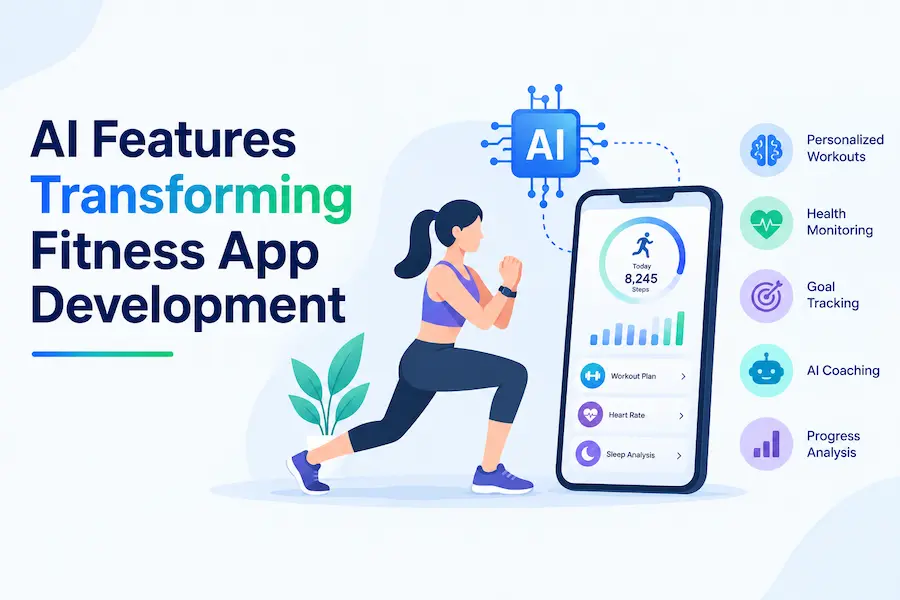
Fitness apps have moved far beyond basic step counters, calorie calculators, and workout libraries. Users now expect fitness platforms to understand their goals, track their progress, adjust workout plans, and provide useful guidance based on their individual needs. This shift has made artificial intelligence one of the most important technologies influencing modern fitness app development.
AI can help fitness applications analyze user behavior, personalize workouts, recommend nutrition plans, process wearable data, provide conversational coaching, and even analyze exercise movements through computer vision. Instead of giving every user the same workout routine, an AI-powered fitness app can continuously adapt its recommendations according to performance, preferences, activity levels, and other available data.
For businesses planning a new fitness platform, this creates an opportunity to build more personalized products instead of another generic workout application. An experienced fitness app development company can combine mobile technology, AI, machine learning, computer vision, APIs, and wearable integrations to create a fitness experience that becomes more useful as users interact with it.
What Is AI-Powered Fitness App Development?
AI-powered fitness app development involves integrating artificial intelligence and machine learning into a fitness application so the platform can analyze information and provide personalized recommendations or automated assistance. Traditional fitness applications generally depend on predefined workout plans, static exercise libraries, and manually configured goals. AI can make these systems more adaptive.
For example, a user may initially select weight loss as a goal and receive a workout plan based on their fitness level. As the user completes workouts, the application can analyze performance, workout frequency, exercise preferences, and progress. The system can then adjust future recommendations instead of continuing to display the same routine.
AI can also support conversational experiences. An AI personal trainer app can answer workout-related questions, explain exercises, suggest modifications, remind users about scheduled sessions, and provide motivation. Computer vision can add another layer by analyzing exercise movements through a smartphone camera and providing feedback about positioning or repetitions.
This combination makes AI fitness app development more than simply adding a chatbot to an existing application. The real value comes from connecting AI with workout data, user profiles, progress tracking, wearable information, and business logic so that the application can make useful recommendations.
Why AI Is Becoming Important in Fitness App Development
The biggest challenge for many fitness applications is keeping users engaged after the initial download. A large workout library alone may not be enough because users can struggle to decide what exercise they should perform, how much intensity they need, or how their routine should change as they progress.
AI can reduce this friction by making the experience more personalized. Instead of asking users to manually search through hundreds of exercises, an intelligent fitness platform can recommend workouts according to their goals, previous activity, available equipment, workout duration, and preferences.
AI can also help businesses understand user behavior. Machine learning models can analyze workout frequency, missed sessions, engagement patterns, and other signals to identify users who may be losing interest. The platform can then deliver more relevant reminders, recommendations, or challenges.
For fitness businesses, this can create a more interactive product while also generating useful insights for improving the customer experience. Current AI fitness solutions commonly combine personalized training, computer vision, recommendation systems, predictive analytics, and conversational AI.
Also Read: - The Future of Fitness Apps : Insights from a Leading Development Company
AI Features Transforming Modern Fitness Apps
AI-Powered Personalized Workout Plans
Personalized workout generation is one of the most practical applications of AI in fitness applications. Instead of assigning identical programs to every user, the application can consider factors such as fitness goals, experience level, available equipment, workout duration, preferred exercises, and previous performance.
For example, a beginner who wants to improve general fitness may receive a completely different program from an experienced user preparing for a strength goal. As users complete workouts, the system can analyze their performance and adjust future sessions.
This makes personalized fitness app development particularly useful for businesses that want to offer individualized experiences at scale. A fitness platform does not necessarily need a human trainer to manually create every routine. AI can handle parts of the recommendation process while trainers or fitness professionals can define rules, review content, and provide expert oversight.
AI Personal Trainer and Virtual Coaching
An AI personal trainer can act as a digital coaching layer inside a fitness application. Users can ask questions, request workout recommendations, understand exercises, or receive guidance during their fitness journey.
Natural language processing and large language models can make these interactions more conversational. Instead of navigating several menus, a user could ask, “Give me a 30-minute lower-body workout without equipment,” and the application could generate an appropriate routine based on the user's stored profile and available exercise library.
Businesses can also use voice-based coaching so users can receive instructions while exercising without repeatedly checking their phones. This can make an AI fitness coach app more interactive and convenient.
However, AI coaching should be designed carefully. Fitness applications should avoid presenting unverified medical advice or making unsafe claims. Where health or injury-related questions arise, the product should direct users toward qualified professionals.
Computer Vision for Exercise Form Analysis
Computer vision is another major area of AI fitness app development. Smartphone cameras can capture movement, while computer vision models can analyze body positions and movement patterns.
For example, an application can use pose estimation to identify key body points during exercises such as squats, lunges, push-ups, or jumping movements. The application can then provide feedback based on predefined movement rules.
This technology can also support automatic repetition counting. Instead of asking users to manually record every repetition, the application can estimate repetitions based on movement patterns.
The important part is to present this feature as guidance rather than a replacement for a qualified fitness or medical professional. Camera-based analysis can be affected by lighting, camera position, clothing, body positioning, and other environmental factors.
AI-Based Fitness Recommendations
Recommendation engines can personalize more than workouts. They can recommend classes, exercises, challenges, training schedules, educational content, and other features based on user behavior.
For example, if someone regularly completes short home workouts in the morning, the application can prioritize similar sessions rather than showing unrelated gym-based programs. If a user repeatedly skips long workouts, the system could recommend shorter sessions.
Recommendation systems can become more accurate as they receive additional behavioral data. This makes them useful for both user engagement and content discovery inside a fitness platform.
AI Nutrition and Meal Recommendations
Nutrition is closely connected with many fitness goals, making AI-powered nutrition features another area businesses can consider.
A fitness application can collect information such as dietary preferences, fitness goals, calorie targets, meal preferences, and allergies. Based on the available information, AI can help generate meal suggestions, grocery lists, or nutrition-focused recommendations.
Some applications can also use image recognition to estimate food items from photographs. Users can take a picture of a meal, and the application can attempt to identify the food and provide an estimated nutritional breakdown.
These systems should clearly communicate that nutritional estimates may not always be exact. The application should also avoid treating AI-generated nutrition information as medical advice.
AI-Based Progress Analysis
Progress tracking has always been a major part of fitness applications, but AI can make the data more useful.
Instead of displaying only weight or workout history, an intelligent system can identify patterns across multiple data points. It may analyze workout consistency, exercise volume, heart rate information, activity levels, sleep information, and other available metrics.
The application can then summarize progress in a way that users can understand. For example, it could highlight improved workout consistency or identify that a user's training frequency has decreased over several weeks.
This turns fitness tracking app development from simple data collection into a more intelligent feedback system.
Wearable and Smart Device Integration
Wearables have become an important data source for modern fitness platforms. Smartwatches and fitness trackers can provide information such as steps, heart rate, activity duration, sleep, and other metrics depending on the device and permissions.
A wearable fitness app development strategy can connect these devices with the mobile application through supported APIs and health platforms. AI can then use the available information to improve recommendations.
For example, an application may use recent activity and recovery-related data when generating workout suggestions. The exact information available depends on the connected device, platform permissions, and integration.
This can create a connected fitness ecosystem where users do not have to manually enter every activity.
AI Chatbots for Fitness Support
AI chatbots can provide users with quick answers throughout the day. A chatbot can explain exercises, answer questions about application features, help users navigate workouts, or provide general fitness information.
Unlike a static FAQ section, a conversational interface can understand questions written in different ways and respond based on the user's context.
A well-designed chatbot can also connect with the application's workout database. This allows it to provide answers based on approved content instead of generating completely unrestricted responses.
For businesses, this can reduce repetitive support requests while giving users access to assistance outside normal customer service hours.
Predictive Analytics for User Engagement
AI can also help fitness businesses understand what may happen next.
Machine learning models can analyze user activity and identify patterns associated with reduced engagement. For example, a user who previously exercised five times per week but has gradually reduced activity may require a different engagement strategy.
The platform can respond with relevant reminders, shorter workout recommendations, challenges, or personalized content.
This is particularly useful for subscription-based fitness applications because user retention directly affects recurring revenue. However, predictions should be treated as signals rather than guaranteed outcomes.
Must Read: - How to Build a Gym Management App: Features and Tech Stack
AI Features for Fitness Business Owners and Trainers
AI does not only benefit end users. Fitness businesses, gyms, personal trainers, and wellness companies can use AI to improve their internal operations.
An admin dashboard can provide information about active users, workout completion, subscription activity, popular programs, engagement trends, and other business metrics. AI can help identify patterns within this data and produce summaries that are easier for administrators to understand.
Personal trainers can also use AI-assisted tools to create initial workout templates, organize exercise libraries, monitor client progress, and identify areas that may require attention. Trainers remain responsible for reviewing and approving plans where professional judgment is required.
For gyms and fitness chains, AI can support personalized member engagement across a larger customer base without requiring every interaction to be manually handled.
Technology Stack for AI Fitness App Development
Building an intelligent fitness application usually requires more than a mobile development framework. The technology stack depends on the features and scale of the product.
For mobile development, businesses can choose technologies such as Flutter, React Native, Swift, or Kotlin depending on platform requirements. Backend systems can be built using technologies such as Node.js, Python, Java, or similar frameworks.
Python is commonly used for machine learning and AI workflows because of its ecosystem of libraries and frameworks. Computer vision systems can use technologies such as OpenCV, MediaPipe, TensorFlow, or PyTorch depending on the specific requirements.
Generative AI features can be connected through suitable large language model APIs, while cloud infrastructure can support data processing, authentication, storage, analytics, and scalable backend services.
The correct technology stack should be selected after defining the product requirements rather than simply choosing the most popular technology.
Must Read: - Develop Your Own Yoga & Meditation App Like Calm & Headspace
How to Build an AI-Powered Fitness App
The development process should begin with a clear product strategy. Businesses need to define their target audience, fitness category, business model, and core problem before selecting AI features.
The next stage involves designing the user experience. User onboarding should collect only information that is useful for personalization. The application can then introduce goals, workout preferences, fitness levels, equipment availability, and other relevant inputs.
After that, developers can build the core application, including authentication, profiles, workout libraries, progress tracking, subscriptions, notifications, and admin functionality. AI capabilities can then be integrated into the appropriate parts of the system.
Testing is particularly important for AI fitness products. Developers need to test not only the application interface but also recommendation quality, chatbot responses, computer vision accuracy, data handling, API reliability, and performance across different devices.
Before launch, businesses should also review privacy, permissions, security, and data-management requirements because fitness applications may handle sensitive personal and wellness-related information.
How Much Does AI Fitness App Development Cost?
The cost of developing an AI-powered fitness application depends heavily on its feature set, AI complexity, platforms, integrations, design requirements, and development team.
A basic fitness application with user profiles, workout libraries, progress tracking, and notifications may cost around $20,000–$40,000.
A mid-level fitness application with subscriptions, personalized workouts, wearable integrations, analytics, and an admin panel may cost approximately $40,000–$80,000.
An AI-powered fitness platform with personalized workout generation, an AI trainer, computer vision, nutrition recommendations, wearable integrations, and advanced analytics can range from approximately $80,000–$180,000+.
An enterprise-level platform with advanced AI models, multiple applications, large-scale infrastructure, complex integrations, and extensive administrative capabilities can exceed $180,000.
These are planning ranges rather than fixed quotations. A detailed estimate from a fitness app development company should be based on the exact features, technology choices, integrations, design scope, and development timeline.
Monetization Models for AI Fitness Apps
Fitness applications can use several monetization strategies. Subscription plans are one of the most common because users can pay monthly or annually for premium workouts, personalized coaching, advanced analytics, nutrition tools, or AI features.
A freemium model can provide basic workouts for free while keeping personalized programs and advanced AI functionality behind a subscription.
Businesses can also offer one-time premium programs, trainer consultations, corporate wellness packages, gym memberships, or partnerships with fitness brands.
The right model depends on the target audience. A consumer fitness application may rely primarily on subscriptions, while a platform designed for gyms or trainers may use SaaS pricing or business accounts.
Must Read: - Diet & Nutrition App with AI Meal Plans for Health Enthusiasts
Why Businesses Are Investing in AI Fitness Apps
The major opportunity is personalization. Traditional applications often provide the same content to large groups of users, while AI makes it possible to create more individualized experiences.
AI can also reduce repetitive manual work. Workout recommendations, basic support questions, progress summaries, content recommendations, and some administrative tasks can be assisted by intelligent systems.
For businesses, this can create a stronger product proposition. Users are not simply downloading an exercise library; they are getting a platform that can respond to their activity and preferences.
The market is also moving toward connected experiences involving mobile applications, wearables, AI coaching, computer vision, and personalized recommendations. Recent industry offerings show these capabilities becoming common themes in modern AI fitness products.
Choosing the Right Fitness App Development Company
Choosing a development partner is important because AI fitness applications combine several technical areas. A company should have experience with mobile development, backend systems, APIs, AI integration, data security, cloud infrastructure, and third-party wearable platforms.
Before selecting a fitness app development company, review its previous applications and ask how it approaches AI integration. A good development process should begin with business requirements rather than immediately recommending a long list of AI features.
The development partner should also explain which AI capabilities are practical for the first version and which features can be introduced later. This helps businesses control development costs while creating a product that can grow over time.
For a company planning an AI fitness app, the goal should not be to add AI simply because it is trending. Each AI feature should solve a specific user or business problem.
Future of AI in Fitness App Development
AI is likely to become increasingly integrated into fitness applications. Future products may combine conversational AI, wearable data, computer vision, predictive analytics, voice interaction, and adaptive training into a single experience.
AI agents may also handle more multi-step fitness workflows, such as creating a weekly training schedule, checking completed workouts, analyzing progress, and adjusting upcoming sessions according to predefined rules.
At the same time, businesses will need to pay greater attention to transparency, privacy, data security, accuracy, and responsible AI use. Fitness applications should clearly communicate what their AI can and cannot do, especially when features touch on health-related decisions.
The most successful products will likely be those that use AI where it genuinely improves the experience instead of adding AI features without a clear purpose.
Conclusion
AI is changing fitness app development by making applications more personalized, responsive, and data-driven. From AI-generated workout plans and virtual personal trainers to computer vision, nutrition recommendations, wearable integrations, progress analysis, and intelligent chatbots, businesses now have several ways to create more useful fitness products.
However, successful AI fitness app development requires more than connecting an AI API to a mobile application. The product needs a clear target audience, reliable fitness content, strong data architecture, thoughtful UX, secure integrations, and responsible AI implementation.
For businesses planning to build an AI-powered fitness platform, starting with the most valuable features and expanding the product over time can be a practical approach. An experienced fitness app development company can help convert the business idea into a scalable application while selecting AI technologies according to the actual requirements of the product.