Dinoustech Private Limited
AI Resume Builder App Development with Job Matching
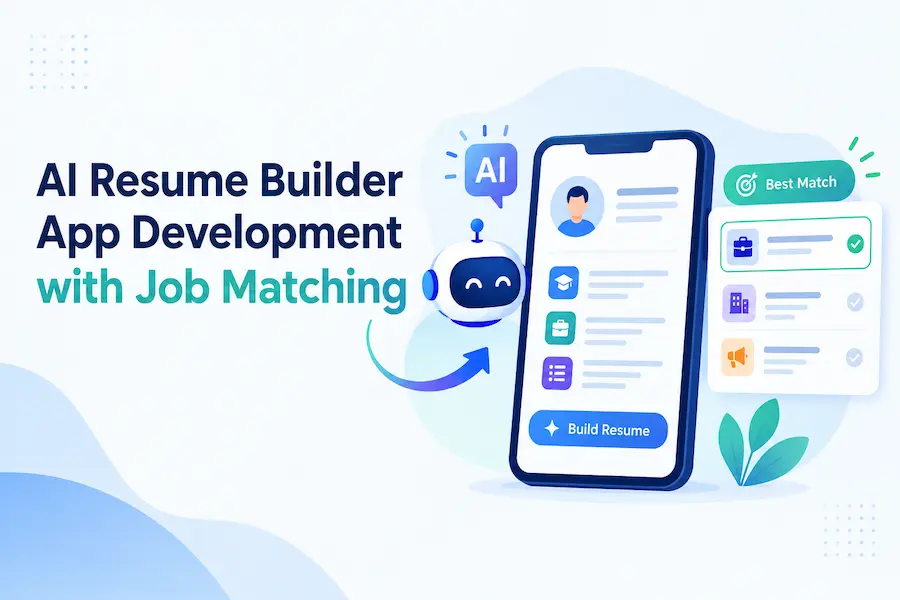
The job market is becoming more competitive, and job seekers need better ways to present their skills and find suitable opportunities. Many candidates apply for jobs using the same resume, even when different positions require different qualifications. Recruiters also receive large numbers of applications, making it difficult to identify suitable candidates quickly. An AI resume builder app with job matching can address these challenges by helping users create professional resumes, improve their content, and connect with jobs that fit their skills and experience.
Unlike a basic resume maker, an AI-powered resume builder can analyze a candidate's profile, suggest relevant skills, improve resume wording, and compare the resume with job descriptions. The job-matching system can then recommend positions based on experience, qualifications, skills, career interests, and other relevant factors. These capabilities create opportunities for startups, recruitment businesses, HR technology companies, and entrepreneurs planning to launch a career development platform.
Developing this type of application requires careful planning, AI integration, user-friendly design, and reliable job data. Businesses must also consider resume privacy, recommendation accuracy, and the cost of running AI services. In this guide, we explain how to build an AI resume builder app with job matching, its essential features, development process, estimated cost, technology stack, and revenue models. We also explain how Dinoustech can help businesses plan custom AI-powered applications around their product goals.
What Is an AI Resume Builder App with Job Matching?
An AI resume builder app is a digital platform that helps job seekers create, edit, improve, and manage resumes using artificial intelligence. Users can enter their education, work experience, skills, certifications, and career goals. The application organizes this information into a professional resume and may suggest improvements based on the user's target role.
The job-matching feature adds another layer of functionality. Instead of stopping after creating a resume, the application compares the candidate's profile with available job listings and recommends relevant opportunities. For example, a software developer with experience in React, Node.js, and cloud technologies may receive recommendations for suitable full-stack or backend development positions, depending on their experience and preferences.
A modern AI resume builder app can combine resume generation, ATS-friendly formatting, skill-gap analysis, job recommendations, application tracking, and interview preparation. Some platforms may also support cover letter generation and professional profile optimization. The objective is to help users manage more of their job search through one application.
For businesses, this creates an opportunity to build a subscription-based career platform or integrate resume tools into an existing job portal. The right feature set depends on the target audience, whether it includes fresh graduates, experienced professionals, freelancers, recruitment agencies, or employers.
Also Read: - How to Build an AI-Powered Enterprise Mobile App?
Why Invest in AI Resume Builder App Development?
Job seekers often struggle to write resumes that communicate their experience clearly. They may not know which skills to highlight, how to describe their achievements, or how to tailor their applications to different positions. An AI resume builder can simplify these tasks by providing structured guidance and suggestions based on the user's profile.
Job matching can make the experience more useful by connecting resume creation with the next step in the hiring process. A candidate who creates a resume for a data analyst role could receive job recommendations that reflect their analytical skills, tools, experience level, preferred location, and salary expectations where available. This reduces the need to search manually through unrelated listings.
Businesses can also benefit from the data and services offered by a well-designed platform. A career technology startup can build a recurring subscription model, while an existing job portal can add AI resume tools to improve user engagement. Recruitment agencies may use resume analysis and candidate matching to organize profiles and identify potential applicants for client vacancies.
An experienced AI resume builder app development company can help turn these requirements into a product with a clear development roadmap. Dinoustech can help businesses plan custom application features, AI workflows, and supporting software components according to their intended audience and business model.
Essential Features of an AI Resume Builder App
The success of an AI resume builder depends on how effectively its features solve everyday problems for job seekers. The first version should focus on resume creation, profile management, and relevant job recommendations before adding more complex capabilities.
1. User Registration and Profile Management
Users should be able to create accounts using email, phone number, or supported social login options. During onboarding, the app can ask for basic information such as education, work experience, target job roles, preferred locations, and career interests.
A complete profile allows the application to generate more relevant resumes and job recommendations. Users should be able to update their details, add certifications, upload an existing resume, and maintain different versions for different career paths. For example, a candidate may keep separate resumes for project management and business analysis roles.
The platform should protect personal information and allow users to manage their account settings. Clear consent, secure authentication, and transparent data handling are important because resumes may contain contact details, employment history, and other personal information.
2. AI-Powered Resume Creation
An AI resume builder should guide users through a simple process for creating a resume. Users can enter information manually, import an existing resume, or provide details through a guided questionnaire. The system then organizes the content into sections such as professional summary, work experience, education, skills, and certifications.
AI can help users improve sentence structure, remove repetitive wording, and explain responsibilities more clearly. For instance, instead of writing “worked on sales,” the app could help the user describe specific responsibilities and measurable outcomes, provided the user supplies accurate supporting details.
The system should never invent qualifications, employment history, certifications, or achievements. It should generate suggestions that users can review and edit before saving. This approach keeps the resume useful while allowing candidates to remain responsible for the accuracy of their information.
3. Professional Resume Templates
Resume templates help users present their experience in a consistent format. The app can provide templates for fresh graduates, experienced professionals, technical roles, management positions, and other career categories.
Templates should support readable typography, clear section headings, and sensible spacing. Users may want to change fonts, section order, colors, and layouts while preserving a professional appearance. The application should also provide PDF downloads and, where required, other export formats.
For ATS-friendly resumes, avoid layouts that depend heavily on graphics, complex tables, or information placed in headers and footers that some systems may parse incorrectly. The app should explain that ATS compatibility depends on the employer's software and document processing rules; no template can guarantee that a resume will pass every screening system.
4. AI Resume Analysis and Improvement
A resume analysis tool can review the user's content for missing information, unclear descriptions, repetitive phrases, and weak presentation. It may suggest improvements to the professional summary, work experience, skill sections, and overall structure.
For example, if a candidate applies for a product manager position, the system could recommend making relevant experience with product roadmaps, stakeholder coordination, and data analysis more visible when those skills genuinely appear in the candidate's background.
The app can also compare the resume with a selected job description and highlight relevant skills that are missing or insufficiently explained. Its recommendations should distinguish between skills the user already has and qualifications they may need to develop. This makes the feature more useful than a simple score or generic checklist.
5. Job Description and Cover Letter Generation
Some candidates struggle to explain why they are suitable for a particular role. An AI writing assistant can help users prepare a cover letter based on their resume and a job description.
The system can suggest an introduction, connect relevant experience to the employer's stated requirements, and organize the letter into clear paragraphs. It can also help users adjust the tone for different industries or seniority levels.
The app should use verified information from the candidate's profile and allow users to edit every generated sentence. It should not invent company knowledge, achievements, or experience. These safeguards help maintain the credibility of the application.
6. AI-Powered Job Matching
Job matching is one of the most important features in this type of application. It compares the candidate's profile with available job listings and recommends roles based on relevant qualifications, skills, experience, and preferences.
A basic system may use filters and keyword matching. An advanced system can use natural language processing and semantic similarity to identify related skills even when the wording differs between a resume and a job description. For example, a candidate's experience with “customer relationship management” may be relevant to a vacancy that mentions CRM platforms.
The matching system can consider job title, required skills, experience level, location, work arrangement, industry, and other available criteria. Users should be able to understand why a position appears in their recommendations, such as a strong skills match or relevant industry experience.
Job matching should support decision-making rather than claim to predict employment success. A high match score does not guarantee an interview, and a lower score should not automatically prevent a candidate from applying.
7. Skill Gap Analysis
Skill gap analysis helps candidates compare their current profile with the requirements of their target roles. The app can identify skills that appear frequently in relevant job descriptions but are missing from the user's resume or profile.
For example, a candidate applying for data analyst positions may notice repeated requirements for SQL, spreadsheet analysis, data visualization, or Python. The application can organize these findings and recommend learning resources or practical projects.
The system must clearly distinguish between a skill that is missing from the resume and a skill the candidate does not actually possess. Users should be able to confirm their abilities before updating their profile. This prevents the app from encouraging inaccurate claims and makes the recommendations more meaningful.
8. Personalized Job Alerts and Application Tracking
Users should receive relevant notifications when new positions match their preferences. They may choose alerts based on job title, location, remote work options, experience level, or selected industries.
An application tracker can record saved jobs, submitted applications, interview dates, follow-up reminders, and application status. This helps users manage multiple opportunities without relying on separate spreadsheets or notes.
Notifications should remain configurable so users can control their frequency. The platform should also provide clear ways to unsubscribe from promotional messages and avoid sending unnecessary alerts that reduce user engagement.
9. Interview Preparation and AI Career Assistance
An AI career assistant can help users prepare for interviews by generating practice questions based on a job description and the candidate's experience. It can provide sample answer structures, explain relevant technical concepts, and suggest areas for further preparation.
Some versions may include mock interviews through text or voice, with feedback on clarity, relevance, and answer structure. If the app analyzes voice or video, it should clearly explain what data it processes and obtain appropriate permission.
The system should not claim to accurately measure a person's personality, honesty, or future job performance from facial expressions or voice patterns. Feedback should focus on practical communication and preparation rather than unsupported judgments.
Must Read: - Mobile App Growth Hacking Techniques That Work
Advanced AI Technologies Used in Resume Builder Apps
A modern AI resume builder combines several technologies to understand resumes, interpret job descriptions, generate content, and recommend opportunities. The technology choices depend on the required accuracy, data volume, budget, and user experience.
Natural Language Processing
Natural language processing (NLP) helps the application extract useful information from unstructured text. It can identify skills, job titles, qualifications, work experience, certifications, and other details from uploaded resumes and job descriptions.
The extracted information can be organized into structured profiles that support search and matching. Developers should test the system with different resume formats, languages, and writing styles because parsing accuracy can vary across documents.
Large Language Models
Large language models can support resume rewriting, professional summaries, cover letters, job description explanations, and interview preparation. The application can provide relevant user information and instructions to the model, then display its response for review.
The development team should implement limits to reduce fabricated claims, inappropriate recommendations, and exposure of private data. Where practical, structured outputs and validation rules can improve consistency. AI-generated content should remain editable rather than being automatically published as a final resume.
Semantic Search and Recommendation Systems
Semantic search helps identify related meanings instead of relying only on exact keyword matches. A recommendation system can compare a candidate's skills and preferences with job requirements, then rank relevant vacancies.
Developers may use text embeddings, vector search, ranking algorithms, or hybrid approaches combining semantic similarity with explicit filters. A hybrid model is often useful because it can capture related skills while still respecting practical requirements such as location, experience, and job type.
The system should be evaluated using real-world test cases and relevant performance measures. Recommendation quality depends on the completeness and freshness of job data as well as the design of the matching logic.
Resume Parsing and Document Processing
Candidates may upload resumes in PDF or DOCX formats. Document processing tools can extract text and identify important sections, while optical character recognition (OCR) may help with scanned documents when supported.
The application should validate extracted information and let users correct mistakes before creating a profile. Parsing failures should produce clear guidance instead of silently creating inaccurate employment histories or skill lists.
How to Develop an AI Resume Builder App with Job Matching
A structured development process helps businesses control cost, reduce technical risks, and launch a product that addresses actual user needs.
Step 1: Research the Market and Define the Target Audience
Start by deciding whom the application will serve. Fresh graduates may need resume templates, career guidance, and entry-level job recommendations. Experienced professionals may prioritize role-specific resumes, skill analysis, and career transitions. Recruitment businesses may need additional tools for candidate search and profile management.
Research competing products, review user feedback, and identify gaps your app can address. Speak with potential users to understand which tasks take the most time and which features they would actually use. This research should inform the product's value proposition and feature priorities.
Step 2: Define the MVP Scope
A minimum viable product (MVP) includes the essential features needed to test your business idea. An initial version might offer user registration, resume creation, templates, resume analysis, job search, basic job matching, saved jobs, and an admin dashboard.
Advanced features such as voice-based mock interviews, multilingual resume generation, recruiter subscriptions, and detailed career analytics can be introduced later. A focused MVP helps you test demand before investing in complex AI workflows.
Step 3: Design the User Experience
Design should make resume creation and job search straightforward. Users should be able to understand what information they need to provide, how the app uses that information, and how to improve their resume.
Create wireframes for onboarding, resume editing, template selection, job recommendations, and application tracking. Test the main workflows with potential users before development. The interface should work well on mobile devices and accommodate users with different levels of technical experience.
Step 4: Select the Technology Stack
The technology stack should support mobile development, AI processing, data storage, job search, and secure integrations.
Flutter or React Native may support cross-platform mobile apps. Backend options include Node.js, Python, Java, or .NET. PostgreSQL or MySQL can store structured user profiles, applications, and job records, while search technologies and vector databases may support more advanced matching.
AI services can include language models, NLP libraries, embedding models, and document extraction tools. The team should compare hosted services with self-managed models based on privacy, accuracy, operating cost, and scalability.
Step 5: Develop the AI and Job-Matching Engine
The team should define how the system extracts candidate information, processes job descriptions, calculates relevance, and presents recommendations. Start with clear matching criteria, then evaluate whether semantic search improves the results.
The system should explain the reasons behind recommendations and allow users to adjust their preferences. Developers should test edge cases, incomplete profiles, outdated job listings, and different resume formats. Matching logic should be reviewed regularly to identify unfair patterns or recommendations that systematically exclude suitable candidates.
Step 6: Integrate Job Data Sources
Job matching requires reliable job listings. Depending on the business model, you may use employer-submitted vacancies, licensed job feeds, authorized third-party APIs, or listings from partner recruitment companies.
Confirm the provider's terms before using external job data. The platform should maintain accurate job descriptions, application links, locations, and closing dates where available. It should also remove expired listings and avoid presenting duplicate vacancies as separate opportunities.
Step 7: Test and Launch the Application
Testing should cover account security, resume uploads, document exports, AI output quality, job recommendations, notifications, and application tracking. The team should also test performance under higher user loads and confirm that one user's resume cannot be accessed by another unauthorized user.
Launch with a controlled group of users when possible. Track resume completion rates, job recommendation clicks, application activity, parsing errors, and user feedback. These measurements can help determine which features need improvement before expanding the platform.
Step 8: Maintain and Improve the Product
After launch, monitor technical performance, AI usage costs, job data quality, user feedback, and security issues. Update the app to support new operating system versions and fix problems discovered through real usage.
Improve recommendations based on appropriate user feedback and carefully evaluated outcomes. Maintain clear privacy settings and retention policies, especially for uploaded resumes and AI conversations. Ongoing improvement is important because job requirements, user expectations, and AI technologies change over time.
Also Read: - Top 10 Mobile App Development Companies in India
How Much Does AI Resume Builder App Development Cost?
The cost of AI resume builder app development depends on the number of features, mobile platforms, AI services, job data integrations, design requirements, and expected user volume. A basic resume maker costs less than a full career platform with semantic job matching, personalized recommendations, and interview assistance.
The following figures are indicative estimates in Indian rupees for initial planning. They are not fixed quotations, and the actual budget may differ according to the project scope and implementation approach.
|
App type |
Estimated development cost |
Typical features |
|
Basic AI Resume Builder |
₹4 lakh–₹6 lakh |
Resume templates, profile management, basic AI writing assistance |
|
Resume Builder with Job Matching |
₹6 lakh–₹12 lakh |
Resume analysis, job search, matching, alerts, saved jobs |
|
Advanced AI Career Platform |
₹12 lakh–₹25 lakh+ |
Semantic matching, skill gap analysis, interview assistant, analytics |
|
Enterprise Platform |
₹25 lakh–₹50 lakh+ |
Large-scale integrations, advanced administration, custom AI workflows, enhanced security |
These estimates depend on whether the project includes one mobile app or separate Android and iOS apps, a web application, an administration dashboard, and external integrations. Enterprise requirements, high-volume AI processing, multilingual support, and complex recommendation systems may increase the budget.
Factors That Affect the Cost
AI complexity: Basic text suggestions require less work than semantic job matching, custom recommendation models, and advanced interview tools.
Job data integrations: Authorized job feeds, employer integrations, and third-party APIs may involve development effort and recurring provider charges.
Platform requirements: Android, iOS, and web interfaces each require design, implementation, testing, and ongoing support. Cross-platform development can reduce duplicated effort in suitable projects.
Security and privacy: Secure resume storage, account permissions, data deletion workflows, monitoring, and appropriate privacy controls are important development considerations.
Ongoing operating costs: Hosting, AI model usage, document processing, email and SMS notifications, monitoring, maintenance, and support should be included in the long-term budget.
Businesses should request a detailed estimate that separates initial development from recurring service charges. This makes it easier to plan for both launch and future growth.
How Long Does It Take to Build an AI Resume Builder App?
A basic AI resume builder may take around 8–12 weeks, depending on the scope and team size. A platform with resume analysis, job search, and matching may take approximately 3–5 months. An advanced AI career platform with complex integrations, semantic recommendations, interview assistance, and enterprise administration may take 5–9 months or longer.
These are approximate planning ranges. The actual timeline depends on design approvals, AI service selection, job data availability, testing requirements, and changes during development. A phased release can help businesses launch the core features first and introduce more advanced capabilities after evaluating user feedback.
Also Read: - How AI is Transforming the Mobile App Industry
How Can an AI Resume Builder App Generate Revenue?
A well-planned business model can help cover development and operating costs while offering useful services to job seekers.
Freemium Subscription Model
The app can offer basic resume creation and job search for free while charging for premium templates, multiple resume versions, advanced resume analysis, and additional AI writing assistance. Monthly and annual subscriptions can provide recurring revenue.
The free version should still deliver genuine value. Clearly explain the limits of AI usage and premium features before asking users to upgrade.
Pay-Per-Resume or Credit-Based Plans
Users may purchase credits for specific services, such as generating a tailored resume, analyzing a job description, or preparing a cover letter. This model can suit candidates who need occasional help instead of a monthly subscription.
Pricing should reflect AI service costs and the value delivered. The app should clearly show how many credits a task uses and what the user receives.
Career Coaching and Interview Preparation
The platform may offer paid career guidance, interview practice, resume reviews, or access to qualified career coaches. AI tools can help prepare users for these sessions, while professional coaches handle personalized guidance when required.
Employer and Recruitment Services
With suitable consent and privacy safeguards, the platform may offer employer accounts, job posting packages, or recruitment tools. Employers could pay to publish vacancies or access features that help organize applications, subject to applicable rules and transparent platform policies.
Partnerships and Learning Resources
The app can partner with training providers, certification platforms, or career education services. Relevant courses can be recommended when users identify skill gaps. Any paid partnership or sponsored recommendation should be disclosed clearly, and recommendations should remain relevant to the user's goals.
Security, Privacy, and Responsible AI
An AI resume builder processes sensitive professional information, including employment history, contact details, qualifications, and career preferences. Users should know how the app stores their data, which AI services process it, and whether information is shared with employers or external providers.
Use secure authentication, encrypted connections, controlled access, and appropriate data retention policies. Allow users to update or delete their profiles and uploaded resumes according to the platform's policies and applicable requirements. Avoid retaining documents longer than necessary.
Responsible AI is equally important. Job recommendations should be tested for unfair patterns, and the app should not treat a match score as a final judgment about a candidate's ability. Provide understandable explanations, let users correct profile information, and avoid using protected characteristics or inappropriate proxies to rank job seekers. Employers should remain responsible for their hiring decisions.
Why Choose Dinoustech for AI Resume Builder App Development?
Choosing an experienced AI resume builder app development company can help you plan the product architecture, integrate AI capabilities, and build a platform that supports future improvements. The development partner should understand mobile app workflows, backend systems, data security, AI integrations, and the practical challenges of job matching.
Dinoustech provides custom software and application development services for businesses planning digital products around specific user needs. For an AI resume builder, the project scope can include resume creation, AI-powered content suggestions, job matching, skill gap analysis, job alerts, application tracking, and an administration dashboard. The final features and integrations should be selected according to the target market, available data sources, budget, and launch priorities.
Dinoustech can help businesses organize the development process into manageable stages, starting with requirements and user experience design before moving into development, testing, and deployment. A phased plan can make it easier to validate the core product before adding more advanced AI features. The team should also define how the application will handle user data, AI service costs, job listing updates, and post-launch maintenance.
Before selecting any development partner, review the proposed scope, timeline, technology choices, testing process, support arrangements, and source code ownership terms. These details help set clear expectations and support the long-term management of the application.
Future Trends in AI Resume Builder and Job Matching Apps
AI resume builder apps may continue to develop into broader career management platforms. Instead of helping users create a single document, future products can support the entire job search journey, from profile creation and skill development to job recommendations, interview preparation, and application tracking.
More advanced semantic matching can help connect related skills with suitable job requirements even when employers and candidates use different terminology. Multilingual support may also help users prepare resumes for different markets and understand job descriptions in their preferred language. Voice-based assistance and conversational career tools could make the experience more accessible to people who prefer guided interactions.
Personalization will remain important, but it must be balanced with transparency and privacy. Users should understand why the app recommends a role and retain control over their information. Businesses that combine useful AI features with reliable job data and responsible design can build a more practical career product than one that focuses only on generating text.
Conclusion
AI resume builder app development with job matching brings resume creation and job discovery together in one platform. Features such as AI writing assistance, resume analysis, professional templates, semantic job matching, skill gap analysis, job alerts, and interview preparation can help users manage their career journey more efficiently.
The cost and timeline depend on the product's complexity, AI capabilities, job data integrations, and platform requirements. Businesses should start with a clear target audience and an MVP that solves the most important user problems. They can then improve matching quality, add premium services, and expand the platform based on actual usage.
If you are planning to launch an AI-powered resume builder or career development platform, Dinoustech can help you plan a custom solution based on your business objectives and technical requirements. A strong product strategy, responsible AI implementation, reliable job data, and ongoing improvement can help create a platform that delivers practical value to job seekers.