Dinoustech Private Limited
How to Develop Custom Gym Management Software in Australia
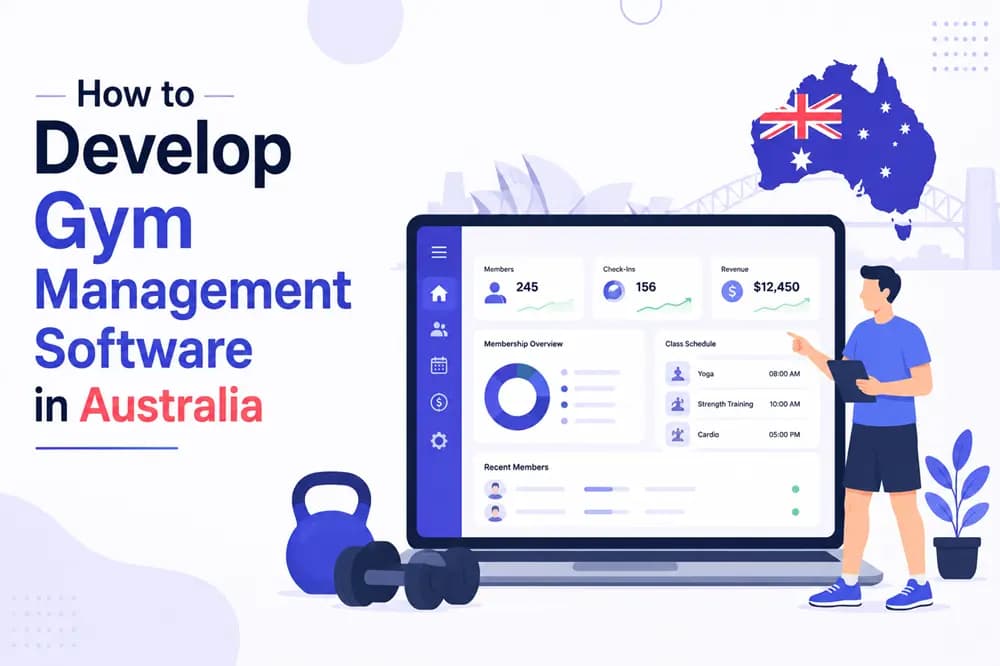
The Australian fitness industry is becoming more technology-driven. Gym owners, fitness studios, health clubs, personal trainers, and multi-location fitness businesses now need software that can handle memberships, payments, bookings, staff, communication, marketing, and reporting from one platform.
Custom gym management software can solve these operational challenges while giving businesses more control over their data and workflows. Instead of adapting the business to a ready-made platform, owners can build features around their actual processes.
The Australian gyms, health and fitness clubs market reached $5.3 billion in 2025, growing 3.66% during the year. The market recorded a 7.5% CAGR between 2020 and 2025.
At the same time, the global gym management software market was estimated at USD 2.03 billion in 2025 and is expected to reach USD 2.23 billion in 2026, with a projected CAGR of 10.24% through 2032.
These numbers show why fitness businesses are investing in digital systems. But what does it take to develop gym management software in Australia? This guide explains the process, features, technology, AI opportunities, costs, timeline, and business considerations.
Why Build Custom Gym Management Software in Australia?
Gym businesses often use separate tools for memberships, payments, attendance, classes, staff management, marketing, and customer communication. When these systems do not communicate properly, staff spend more time managing data instead of serving members.
Custom gym management software brings these operations together. A gym owner can manage memberships, check-ins, payments, class schedules, trainers, customer communication, reports, and marketing from one dashboard.
The software can also support different business models. A boutique fitness studio may need class scheduling and package management, while a large gym chain may require multi-location management, access control, staff permissions, centralized reporting, and franchise-level analytics.
The Australian market includes opportunities across Sydney, Melbourne, Brisbane, Perth, Adelaide, Canberra, Hobart, Darwin, and regional areas. A custom platform can support different membership structures, pricing models, locations, and customer requirements across these markets.
What Features Should Custom Gym Management Software Include?
A successful platform should start with the operational problems it needs to solve. Member management forms the foundation. Staff should be able to create profiles, manage membership plans, update customer information, view attendance history, and track membership status.
Class and appointment scheduling should allow members to book classes, cancel reservations, join waiting lists, and receive reminders. Gym owners can manage trainer availability, room capacity, recurring classes, and peak-hour demand.
Payment and billing features should support membership payments, invoices, recurring billing, discounts, refunds, packages, and payment history. Integration with suitable Australian payment providers can make transactions easier for both businesses and members.
Attendance management can use QR codes, mobile check-ins, RFID, biometric systems, or access-control integrations. The right option depends on the gym's size, security requirements, and budget.
A CRM module can store leads, member interactions, enquiries, follow-ups, campaigns, and retention information. Automated reminders can help staff contact prospects and inactive members at the right time.
Staff management can cover trainers, receptionists, managers, payroll-related information, permissions, schedules, and performance reports.
The admin dashboard should bring the main business metrics together. Owners can monitor active memberships, new registrations, cancellations, revenue, attendance, bookings, leads, and other KPIs.
Also Read: - How to Build a Gym Management App: Features and Tech Stack
How to Add AI to Gym Management Software
AI is becoming a major part of fitness technology. A 2025 ABC Fitness report found that 49% of consumers surveyed used an AI-based fitness or wellness app daily, while 55% expressed concerns about data and privacy. The same report found an 8% year-over-year increase in gym and studio check-ins and a 27% increase in new member joins across the data it analyzed.
For gym management software, AI should focus on practical business problems.
An AI lead scoring system can analyze enquiries and identify prospects who are more likely to convert. An AI retention system can identify members whose activity or attendance patterns indicate a higher churn risk.
AI can also automate customer support. A virtual assistant can answer questions about memberships, class schedules, opening hours, payments, and bookings. It can operate outside normal reception hours and transfer complex questions to staff.
AI-powered analytics can identify attendance trends, popular classes, busy periods, membership patterns, and revenue changes. Gym owners can use these insights to improve staffing and scheduling.
Personalization provides another opportunity. Software can recommend suitable classes, training programs, or content based on a member's goals and activity history.
However, Australian gym operators must treat personal and health information carefully. AI features should use appropriate security controls, access permissions, data governance, and privacy processes. Businesses should not send sensitive member information to consumer AI tools without proper safeguards.
Mobile App and Website Integration for Australian Gyms
A modern gym platform should not stop at an admin dashboard. Members increasingly expect to manage their fitness activities from their smartphones.
A connected gym app can allow users to view memberships, book classes, check schedules, make payments, receive notifications, track attendance, communicate with trainers, and access workout content.
A website also plays an important role in customer acquisition. A gym website creation company can build a website that presents memberships, classes, trainers, locations, pricing, schedules, testimonials, and contact information.
The website can connect directly with the management platform. For example, a visitor can select a membership plan online, create an account, complete payment, and receive access without requiring staff to manually enter the information.
This creates a connected ecosystem involving the gym website, member mobile app, admin dashboard, payment gateway, CRM, access-control system, and analytics platform.
Must Read: - Develop a Fitness Tracking App Like MyFitnessPal: Features & Cost
How to Develop Custom Gym Management Software Step by Step
The first stage involves business and user research. The development team should understand how the gym currently handles memberships, bookings, payments, attendance, staff operations, marketing, and reporting.
The next stage involves defining the MVP. The MVP should include the features needed to operate the business effectively. A typical MVP can include member management, membership plans, payments, scheduling, attendance, notifications, staff management, and an admin dashboard.
The design team then creates the UX architecture and interface. The design should make common tasks quick. Reception staff should not need multiple screens to check a membership or confirm a booking.
Developers then build the frontend, backend, APIs, database, authentication, payment integrations, and other required components.
Testing should cover functionality, security, performance, mobile responsiveness, payment processing, access permissions, integrations, and different user roles.
After deployment, the development team monitors performance and user feedback. The business can then introduce additional features based on actual usage rather than assumptions.
This approach supports continuous optimization. The product evolves through real data, member feedback, business KPIs, and changing market needs.
Technology Stack for Gym Management Software
The technology stack should match the size and requirements of the platform. A web-based admin dashboard can use technologies such as React, Angular, Vue, or another suitable frontend framework.
The backend can use Laravel, Node.js, .NET, Java, Python, or another technology based on the team's expertise and project requirements.
A relational database such as MySQL or PostgreSQL can handle structured information such as members, memberships, payments, schedules, and transactions. Additional technologies can support caching, search, analytics, or real-time communication.
Cloud infrastructure can help the platform scale as the number of locations and members grows. APIs can connect payment gateways, accounting systems, access-control devices, email services, SMS providers, wearable platforms, and other business tools.
AI functionality can use machine learning models or carefully selected AI APIs depending on the use case. The development team should evaluate accuracy, privacy, cost, latency, and maintenance before choosing an AI architecture.
Cost to Develop Custom Gym Management Software in Australia
The cost depends on the software's complexity, number of platforms, integrations, design requirements, development location, security requirements, and AI functionality.
A basic custom gym management system may cost around AUD 10,000–30,000. This level can include member management, memberships, attendance, scheduling, payments, notifications, and a basic admin dashboard.
A mid-level platform may cost approximately AUD 30,000–50,000. It can include CRM, staff management, advanced reports, mobile applications, multiple payment integrations, automated marketing, role-based access, and third-party integrations.
An advanced multi-location platform can cost AUD 50,000–100,000+. It may include AI analytics, predictive member retention, access-control integration, advanced CRM automation, mobile apps, franchise management, real-time dashboards, custom APIs, and enterprise security.
These are planning ranges rather than fixed quotations. A detailed project specification is required before a development company can provide an accurate estimate.
Also Read: - The Future of Fitness Apps: Insights from a Leading Development Company
How Long Does It Take to Build Gym Management Software?
A basic gym management platform may take approximately 3–5 months to develop. A medium-complexity platform can require around 5–8 months, while an enterprise solution with multiple integrations, mobile apps, AI, and multi-location support may take 8–12 months or longer.
The timeline depends on how quickly the business finalizes requirements, approves designs, provides third-party integration information, and completes testing.
An MVP approach can reduce the initial launch timeline. After launch, the business can add AI automation, advanced analytics, wearable integration, marketing automation, and other features based on customer demand.
How to Choose a Gym Management Software Development Company
The right development partner should understand both software development and fitness business operations.
When evaluating a gym management software development company, businesses should review its experience with SaaS platforms, mobile apps, payment systems, CRM, cloud infrastructure, APIs, AI, security, and custom dashboards.
The team should also understand Australian business requirements, privacy considerations, payment workflows, and user expectations.
Businesses looking for gym app developers in Australia should also evaluate whether the development partner can build the complete ecosystem rather than only a mobile application. A strong platform may require a website, admin dashboard, mobile app, backend, APIs, payment system, analytics, and integrations.
Dinoustech is a software and web development company that can help businesses build custom web and mobile solutions, SaaS platforms, AI-enabled systems, and business management software.
For businesses that need both a member-facing website and digital management platform, working with a gym website creation company alongside a software development team can help maintain consistent branding, data flow, and user experience.
Gym Management Software Trends in Australia for 2026
Cloud-based gym software continues to gain importance because it allows businesses to manage systems across locations without maintaining large local infrastructure. Industry research also identifies cloud deployment and growing demand for automation as important trends in the Australian gym management software market.
AI-powered retention is another important area. Instead of waiting for members to cancel, software can analyze attendance and engagement patterns and alert staff when intervention may help.
Mobile-first member experiences will remain important. Customers expect to book classes, make payments, receive notifications, and manage their accounts from their phones.
Automated marketing can also improve operations. The platform can send personalized reminders, membership renewal messages, promotional campaigns, birthday messages, and reactivation campaigns based on customer data.
Access control is becoming more connected to gym management platforms. QR codes, mobile credentials, smart locks, and other technologies can help gyms provide controlled access while reducing reception workload.
Data-driven decision-making is another major trend. Owners can use dashboards to identify profitable membership plans, popular classes, low-attendance periods, high-value customers, and potential churn.
AI should remain practical rather than being added for marketing purposes. Current fitness industry research shows strong consumer adoption but also significant concerns about privacy and over-reliance on technology.
Final Thoughts
Custom gym management software can help Australian fitness businesses reduce manual administration, improve member engagement, manage payments, organize classes, monitor performance, and make better decisions using real-time data.
The Australian gyms, health and fitness clubs market reached $5.3 billion in 2025, while the wider global gym management software market is projected to grow from USD 2.03 billion in 2025 to USD 4.02 billion by 2032.
The best approach is to build around real business requirements. Start with the most important workflows, launch a practical MVP, measure user behavior, collect feedback, and improve the platform continuously.
AI, mobile apps, cloud infrastructure, automated CRM, access control, analytics, and personalized member experiences can then be added as the business grows.
For Australian gyms and fitness businesses, the right development partner can turn these requirements into a scalable platform designed for current operations and future growth.
FAQs
How much does it cost to develop custom gym management software in Australia?
A basic platform can cost around AUD 10,000–30,000. A mid-level system can cost approximately AUD 30,000–50,000, while advanced enterprise software can exceed AUD 50,000–1,00,000 depending on features and integrations.
What features should gym management software include?
Core features include member management, memberships, billing, payments, class scheduling, attendance, trainer management, notifications, CRM, reports, and an admin dashboard. Advanced systems can add AI, access control, marketing automation, mobile apps, and predictive analytics.
Can AI be integrated into gym management software?
Yes. AI can support lead scoring, churn prediction, customer support, personalized recommendations, attendance analysis, marketing automation, and business forecasting.
How long does it take to develop custom gym software?
A basic system may take 3–5 months. A mid-level platform can take 5–8 months, while a complex multi-location solution with AI and multiple integrations can take 8–12 months or longer.
Should a gym build custom software or buy ready-made software?
Custom software makes more sense when a business has unique workflows, multiple locations, specialized integrations, or plans to create its own fitness technology product. Ready-made software may work better for businesses that need standard features quickly.
Can gym management software include a mobile app?
Yes. A mobile app can allow members to book classes, manage memberships, make payments, check attendance, receive notifications, communicate with trainers, and access fitness content.
What Australian cities can benefit from custom gym software?
Gym businesses in Sydney, Melbourne, Brisbane, Perth, Adelaide, Canberra, Hobart, Darwin, Gold Coast, Newcastle, Wollongong, Geelong, and other Australian cities can use custom gym management platforms to automate operations and improve member experiences.