Dinoustech Private Limited
Best Taxi Booking App Development Company in Maharashtra for 2026
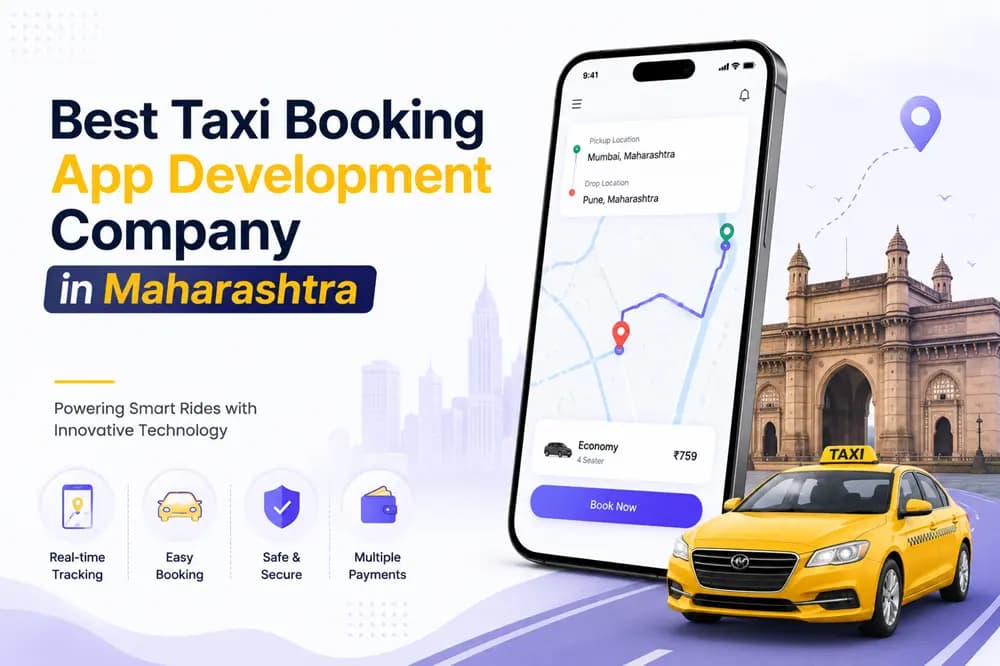
The way people book taxis has changed significantly. Customers now expect quick bookings, accurate fare estimates, live driver tracking, digital payments, and reliable support from a taxi booking app. At the same time, taxi operators and entrepreneurs want technology that can manage drivers, rides, payments, commissions, and customer relationships from one platform.
This shift has created strong opportunities for businesses planning to launch their own ride-hailing platform in Maharashtra. A well-designed taxi booking app can serve daily commuters, airport passengers, corporate users, tourists, and local transport operators.
For businesses planning to enter this market, choosing the right taxi booking app development company is an important decision. The development partner needs to understand mobile technology, location-based services, payment systems, driver management, security, and the local transportation environment.
In 2026, businesses are also looking beyond basic taxi applications. AI-powered matching, predictive demand analysis, automated customer support, route optimization, fraud detection, EV fleet management, and personalized ride recommendations are becoming important parts of modern taxi platforms.
Maharashtra's Taxi Booking Market in 2026
Maharashtra offers a strong market for app-based transportation because it has large urban populations, business hubs, tourism destinations, airports, railway networks, and growing digital payment adoption.
The wider Indian taxi market is also expanding. Mordor Intelligence estimates that India's taxi market will reach USD 23.98 billion in 2026, compared with USD 22.25 billion in 2025. The report projects the market to reach USD 34.87 billion by 2031, representing a CAGR of 7.78%.
Another market estimate from IMARC places the Indian taxi market at USD 23.88 billion in 2025 and projects it to reach USD 46.88 billion by 2034. Its research also indicates that online booking represented 78.6% of the market in 2025, while ride-hailing accounted for 69.2%.
Maharashtra has an important position within this market. Mumbai and Pune generate substantial demand from professionals, students, tourists, airport passengers, and businesses. Other cities such as Nagpur, Nashik, Thane, Navi Mumbai, Kolhapur, and Chhatrapati Sambhajinagar also provide opportunities for regional taxi platforms.
For a new business, this means the opportunity does not depend only on competing in Mumbai. A platform can start with one city and gradually expand into other high-demand locations.
Why Businesses Are Investing in Taxi Booking Apps
Customers prefer digital booking because it gives them more control over their journeys. Instead of searching for an available taxi on the road, they can enter a pickup point, select a destination, compare available vehicle categories, view the estimated fare, and confirm a ride within minutes.
For operators, an app provides much more than ride booking. It creates a centralized system for managing drivers, vehicles, payments, commissions, customer accounts, promotions, complaints, and business reports.
A taxi business can also build multiple revenue channels. These may include ride commissions, driver subscription plans, corporate accounts, airport transfers, premium rides, rental services, advertising, and fleet management services.
In Pune, for example, a platform can focus on daily office commuters and corporate transportation. Mumbai can support airport transfers, business travel, intercity trips, and high-volume daily rides. Nagpur can provide opportunities around railway stations, airports, business areas, and local transportation.
This city-specific approach can help a startup build its customer and driver base before expanding across Maharashtra.
Key Features of a Modern Taxi Booking App
A successful taxi platform normally consists of three major systems: the passenger app, driver app, and admin panel. Each system needs to serve a different purpose while working through the same backend.
The passenger application should provide registration, location detection, pickup and drop selection, fare estimation, vehicle selection, ride booking, live tracking, digital payments, ride history, ratings, cancellation, referral offers, and customer support.
The driver application should handle registration, document verification, online and offline status, ride requests, navigation, earnings, trip history, incentives, ratings, and digital wallet management.
The admin panel gives business owners control over the entire operation. Administrators can manage users, drivers, vehicles, bookings, fares, commissions, payments, complaints, promotions, service areas, and reports.
A modern taxi app can also support scheduled rides, airport transfers, outstation bookings, rental packages, multiple stops, corporate bookings, emergency assistance, and different vehicle categories.
The platform should also support UPI, cards, wallets, net banking, and cash payments where applicable. Digital payment infrastructure has become an important part of India's app-based mobility ecosystem.
AI-Powered Taxi Booking App Development Trends
AI is becoming one of the major technology trends in taxi booking software development. Businesses can use AI to improve operational decisions instead of adding AI only as a marketing feature.
An AI-based taxi booking platform can analyze historical bookings, weather conditions, traffic patterns, locations, time periods, and customer behavior to predict demand. The system can then help operators position drivers in areas where demand is likely to increase.
AI can also improve driver-passenger matching. Instead of matching only by distance, the system can consider estimated arrival time, driver availability, vehicle type, destination patterns, driver ratings, and traffic conditions.
AI-powered customer support can handle common questions related to fares, cancellations, booking status, refunds, and account issues. This can reduce the workload for support teams.
Fraud detection is another useful application. AI models can identify unusual booking patterns, suspicious payment activity, repeated cancellations, fake accounts, or abnormal driver behavior.
Businesses can also use AI for dynamic demand forecasting, personalized ride suggestions, intelligent route recommendations, predictive maintenance, driver performance analysis, and automated business reporting.
These capabilities make AI-powered taxi app development a practical direction for businesses that want to build a scalable platform in 2026.
Taxi App Development Opportunities Across Maharashtra
A major advantage of Maharashtra is the presence of several different transportation markets within one state.
Mumbai can support high-frequency city rides, airport transportation, corporate travel, premium cabs, and intercity services. A taxi platform targeting Mumbai should focus heavily on real-time tracking, quick driver allocation, reliable ETAs, and efficient support.
Pune has a large technology, education, and business ecosystem. A platform can target office commuters, students, corporate transportation, and scheduled rides.
Navi Mumbai and Thane can support daily commuter services connecting residential areas with business districts and transport hubs. Operators can also create airport and railway transfer services.
Nagpur provides opportunities for local rides, airport transfers, railway station pickups, corporate transportation, and outstation bookings.
Nashik can support local transportation along with tourism, business travel, and intercity taxi services. Cities such as Kolhapur, Solapur, Amravati, Sangli, Satara, and Chhatrapati Sambhajinagar can also become expansion markets for a regional taxi platform.
This approach allows businesses to build a Maharashtra-focused network rather than depending entirely on one metropolitan market.
Maharashtra Taxi Regulations and Local Requirements
Regulatory compliance should be considered before launching an app-based taxi service. The technology may be ready, but the business also needs to meet applicable transport and aggregator requirements.
Maharashtra introduced an aggregator policy in July 2026 covering app-based taxi services. Among the reported requirements, aggregator drivers need the required badge and Maharashtra residency documentation, along with knowledge of Marathi. The policy also includes provisions related to fares and other operational requirements.
This development makes local compliance especially important for businesses entering Maharashtra's taxi market in 2026.
A development company should therefore build the platform with configurable fare rules, driver verification, document management, service-area controls, trip records, and administrative reporting. The exact legal requirements should be confirmed with the relevant authorities before commercial launch because transportation regulations can change.
Ola Clone and Uber Similar App Development
Many entrepreneurs use established taxi platforms as references when planning their own products. This has created demand for ola clone app development and uber similar app development.
A clone does not mean copying another company's branding, interface, code, or proprietary features. It generally means developing a platform around a proven business model while creating an independent product with its own brand, user experience, features, and revenue strategy.
An Ola-style platform may include passenger and driver applications, ride booking, fare calculation, driver allocation, GPS tracking, payments, ratings, offers, and an admin dashboard.
An Uber-style platform can also include scheduled rides, multiple vehicle categories, corporate accounts, trip sharing, safety features, automated support, and advanced analytics.
The important part is customization. A Maharashtra-focused business may need Marathi language support, local fare configurations, regional service zones, Maharashtra-specific driver verification, UPI payments, and city-specific operations.
Taxi Booking Website and Web Platform Development
A mobile application is important, but businesses should not ignore the website. A professional website can help attract customers through search engines and provide booking, corporate inquiries, driver registration, fleet partnerships, and service information.
A taxi booking website creation company can build a web platform that connects with the same backend used by the mobile applications. This allows customers to book rides from a browser while administrators manage bookings from a central system.
The website can also target location-based searches such as taxi booking in Mumbai, cab booking in Pune, airport taxi in Nagpur, taxi service in Nashik, and outstation taxi services from Thane.
For SEO, businesses can create useful city and service pages instead of creating hundreds of thin pages with repeated keywords. Each page should provide genuine information about availability, routes, service types, booking options, and customer needs.
How to Choose Taxi Booking App Developers
The development partner can have a direct impact on the quality, scalability, and long-term cost of the platform. Businesses should evaluate developers based on their experience with location-based applications, payment integrations, real-time tracking, cloud infrastructure, API integrations, and scalable backend architecture.
A capable team should also understand UI/UX design, Android and iOS development, web development, database management, cybersecurity, testing, deployment, and post-launch maintenance.
Businesses should also ask how the development team handles peak booking loads. A taxi platform may receive a normal number of bookings during the afternoon and experience a significant increase during office hours, weekends, festivals, bad weather, or major events.
The development team should therefore plan the architecture around scalability from the beginning.
Dinoustech can support businesses looking for a technology partner for taxi platforms, mobile applications, websites, and custom software solutions. As a software and web development company, Dinoustech can work on passenger apps, driver apps, admin panels, web platforms, APIs, payment integration, GPS-based tracking, and AI-enabled functionality.
Cost of Taxi Booking App Development in Maharashtra
The cost of building a taxi booking app depends on the product scope rather than only the number of screens.
A basic taxi app with user registration, booking, GPS tracking, fare calculation, driver management, payments, and an admin panel will require a different investment from a large platform with AI, corporate accounts, subscriptions, rental services, advanced analytics, multilingual support, and multiple vehicle categories.
The technology stack also affects development costs. Android and iOS development can follow native or cross-platform approaches. Backend architecture, cloud infrastructure, third-party map APIs, payment gateways, SMS services, verification systems, and ongoing maintenance also contribute to the total budget.
For an accurate estimate, businesses should first prepare a feature list and launch plan. Starting with a focused MVP can reduce initial development time and allow the company to validate demand before adding advanced features.
Future of Taxi Booking App Development in Maharashtra
The next phase of taxi technology will focus on smarter operations rather than simply adding more features.
AI demand forecasting can help platforms predict where passengers will need rides. Predictive maintenance can help fleet operators identify potential vehicle problems before they cause service disruptions. EV fleet management can help businesses monitor battery levels, charging requirements, range, and vehicle utilization.
Real-time pricing intelligence, voice-based booking, automated support, route optimization, driver analytics, and fraud prevention will also become more important.
The market is already moving toward technology-led mobility. Grand View Research estimates that India's ride-hailing services market generated about USD 2.51 billion in revenue in 2025 and projects it to reach approximately USD 11.06 billion by 2033, with a projected CAGR of 20.7% from 2026 to 2033.
This growth creates opportunities for businesses that can solve specific transportation problems instead of simply launching another generic taxi application.
Final Thoughts
Maharashtra provides a strong environment for taxi booking businesses in 2026. Mumbai, Pune, Nagpur, Nashik, Thane, Navi Mumbai, Kolhapur, Solapur, Amravati, Sangli, Satara, and Chhatrapati Sambhajinagar each have different transportation requirements that businesses can target with the right model.
A successful taxi platform needs more than a booking button. It needs reliable driver allocation, accurate location services, secure payments, strong admin controls, useful customer support, regulatory compliance, and an architecture that can handle growth.
AI can further improve the platform through demand prediction, intelligent matching, fraud detection, route optimization, customer support, and business analytics.
For businesses planning taxi booking app development in Maharashtra, the best approach is to start with a clear target market, build an MVP around real customer needs, measure usage, and continuously improve the platform using customer feedback and operational data. Choosing experienced taxi booking app developers can make this process more reliable and help turn the initial idea into a scalable mobility business.