Dinoustech Private Limited
How to Build AI-Powered Delivery Management Software?
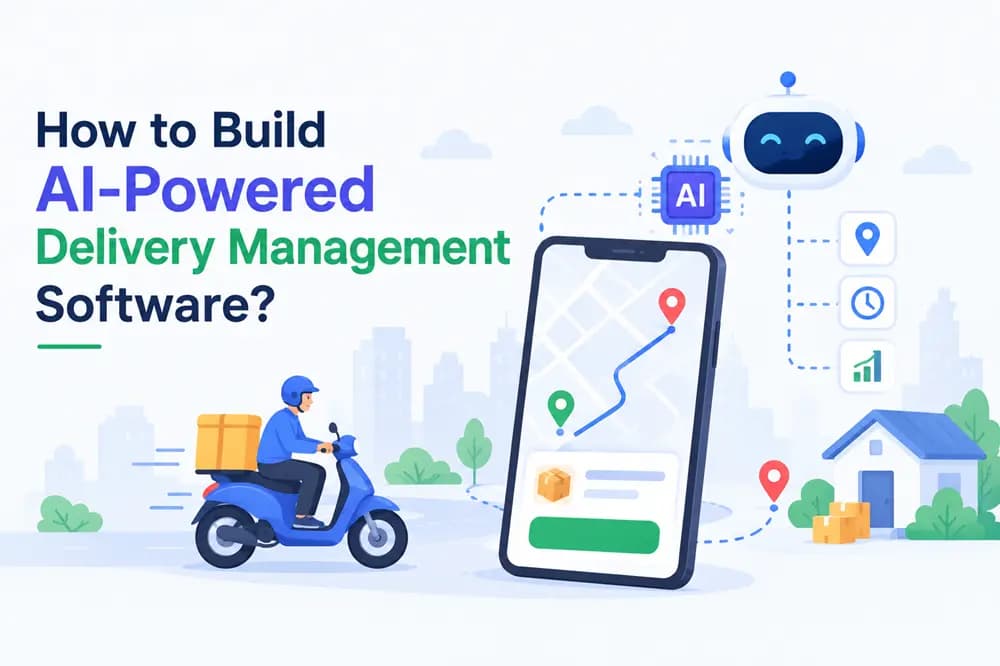
AI-powered delivery management software helps businesses plan deliveries, assign drivers, track orders, optimise routes, and improve customer communication from one platform. Unlike basic delivery tools, an AI-powered system can analyse delivery data, predict delays, recommend better routes, and automate repetitive operational tasks.
Businesses in e-commerce, grocery delivery, food delivery, healthcare, logistics, retail, and courier services are investing in delivery automation to reduce costs and improve delivery speed. However, building reliable software requires more than adding an AI chatbot or route map. The platform must connect orders, drivers, vehicles, warehouses, customers, and business teams through a single workflow.
This guide explains how to build AI-powered delivery management software, including essential features, AI technologies, development steps, estimated costs, market trends, and ways to create a platform that supports real business growth.
What Is AI-Powered Delivery Management Software?
AI-powered delivery management software is a digital platform that helps businesses manage the complete delivery process. It connects order management, dispatching, route planning, driver tracking, customer notifications, proof of delivery, and business reporting.
The software uses artificial intelligence and machine learning to analyse delivery information and support better decisions. For example, it can predict delivery delays by studying traffic, weather, driver availability, delivery locations, and historical performance.
A typical platform includes an admin dashboard, dispatcher panel, driver application, customer tracking interface, and integration with existing business systems. Businesses can use it to manage local deliveries, scheduled orders, same-day deliveries, multi-stop routes, and large delivery fleets.
The goal is simple: deliver the right order to the right customer at the right time while controlling operational costs.
Also Read: - Must-Have Features in Modern Food Delivery Apps
Why Businesses Are Investing in Delivery Management Software
Delivery operations become difficult when businesses manage orders through spreadsheets, phone calls, messaging apps, and separate tracking tools. These methods create delays, duplicate work, poor visibility, and communication gaps between teams.
Custom delivery management software gives businesses real-time control over their operations. Dispatchers can assign orders, drivers can receive delivery instructions, customers can track shipments, and managers can monitor performance from one system.
The market is also growing quickly. The Business Research Company estimates that the global last-mile delivery software market will grow from $3.01 billion in 2025 to $3.36 billion in 2026, reaching $5.21 billion by 2030 at a CAGR of 11.6%. Key growth areas include route optimisation, real-time tracking, fleet management, proof of delivery, and AI-based demand forecasting.
The broader last-mile delivery market is expected to grow from $181.6 billion in 2026 to $348.8 billion by 2033, according to Grand View Research. The growth reflects rising e-commerce activity, faster delivery expectations, and the need for efficient urban logistics.
These trends create opportunities for businesses that build delivery software for specific industries, regions, and operating models.
Must-Have Features of Delivery Management Software
A strong delivery management platform should begin with order management. Businesses need to create, import, update, cancel, and organise delivery orders from one dashboard. The system should capture customer details, delivery addresses, order value, delivery time, special instructions, and payment status.
The platform should also include automated driver assignment. Dispatchers can assign deliveries manually, but the software should recommend drivers based on location, availability, vehicle type, workload, and delivery priority. This reduces manual work and helps businesses use their fleet more effectively.
Real-time GPS tracking is another important feature. Managers should see the current location of drivers, active deliveries, completed orders, and delayed shipments. Customers should receive accurate tracking information without needing to contact customer support.
Proof of delivery helps businesses confirm successful deliveries. Drivers can capture signatures, photographs, OTP verification, timestamps, and customer feedback. These records reduce disputes and support better accountability.
Other important features include delivery scheduling, route planning, customer notifications, payment collection, driver earnings, delivery status updates, analytics, and role-based access.
Must Read: - Why Your Grocery Business Needs a Delivery App in 2026
AI Features That Improve Delivery Operations
AI can improve delivery management by analysing large amounts of operational data and recommending better actions. One of the most valuable applications is AI route optimisation. The system can calculate delivery routes based on traffic, distance, delivery windows, vehicle capacity, road restrictions, and driver availability.
Dynamic routing allows the software to update routes when conditions change. If a driver faces traffic congestion, a vehicle breakdown, or a cancelled order, the system can recommend a new route instead of forcing the driver to follow the original plan.
AI demand forecasting helps businesses predict the number of orders expected in a particular location or time period. Managers can use these insights to schedule drivers, prepare inventory, and reduce delivery backlogs.
Predictive delivery analytics can estimate the probability of late deliveries. The system may identify high-risk orders and notify dispatchers before the delay affects customers.
AI can also support intelligent dispatching, delivery time prediction, customer segmentation, fraud detection, driver performance analysis, and automated support.
The AI should support human decision-making rather than remove control from the operations team. Dispatchers should be able to review, approve, or change AI recommendations when necessary.
AI Chatbots and Customer Communication
Customer communication plays a major role in delivery satisfaction. Customers frequently ask questions such as “Where is my order?”, “When will the driver arrive?”, and “Can I change my delivery address?”
An AI delivery chatbot can answer common questions using real-time order information. It can share tracking updates, explain delivery statuses, collect support requests, and transfer complex issues to a human agent.
Businesses can deploy the chatbot on their website, mobile application, WhatsApp, or customer support portal. A multilingual chatbot can also support customers who prefer regional languages.
The chatbot should connect with the delivery management system instead of providing generic answers. For example, it should retrieve the actual order status before telling a customer that the package is out for delivery.
Generative AI can help the chatbot understand different questions and provide natural responses. However, developers should use a controlled knowledge base and secure API access to prevent inaccurate information and unauthorised data exposure.
Also Read: - How to Build a Grocery Delivery App Like JioMart
Driver App and Fleet Management Features
The driver application is one of the most important parts of delivery management software. Drivers need a simple interface that works well while they are travelling between delivery locations.
The app should allow drivers to view assigned orders, accept or reject tasks according to business rules, access navigation, update delivery status, contact customers, and upload proof of delivery. It should also support online and offline operations when network connectivity becomes weak.
Fleet management features help businesses monitor vehicles, fuel usage, maintenance schedules, mileage, insurance records, and vehicle availability. The software can send alerts when a vehicle needs maintenance or when operating costs increase.
AI can analyse driver performance using delivery completion rates, route adherence, idle time, customer ratings, and late delivery patterns. Managers can use these insights to improve training, workload distribution, and incentive plans.
The application should protect driver privacy and collect only the information required for delivery operations. Businesses should clearly explain how location data is used and stored.
Integrations Required for a Connected Delivery Platform
Delivery software becomes more useful when it connects with other business systems. E-commerce integrations allow the platform to receive new orders automatically from online stores and marketplaces.
Businesses may also integrate payment gateways, accounting software, warehouse management systems, inventory platforms, CRM tools, ERP systems, mapping services, SMS providers, email platforms, and customer support tools.
Map and navigation APIs support location search, distance calculation, geocoding, route planning, and live tracking. Payment integrations allow businesses to manage prepaid orders, cash-on-delivery collections, refunds, and driver cash settlements.
For larger logistics operations, the platform may need integrations with barcode scanners, warehouse systems, parcel management tools, and enterprise resource planning software.
API security is essential. Developers should use authentication, access permissions, encrypted communication, rate limits, and activity logs to protect business and customer information.
How to Build AI-Powered Delivery Management Software
The first step is to define the business model and delivery workflow. A grocery company may need slot-based deliveries, while a courier company may require parcel scanning, multi-stop routing, and proof of delivery. A healthcare delivery business may need temperature tracking, restricted access, and additional compliance controls.
The next step is to research real users. Speak with dispatchers, drivers, warehouse teams, customer support executives, and customers. Identify the problems they face and prioritise features that solve those problems.
After defining the requirements, the development team should prepare the product architecture, database structure, user roles, API plan, AI strategy, and security framework. The team should decide whether to use third-party AI services, open-source models, or custom machine learning models.
Developers then build the admin panel, driver app, customer interface, backend, database, integrations, and AI features. Testing should cover route accuracy, tracking performance, payment security, app usability, API reliability, and unexpected delivery scenarios.
The business should launch a minimum viable product first. After launch, the team can monitor delivery data, customer feedback, driver behaviour, and operational results. Regular improvements help the platform adapt to changing business needs.
Must Read: - Cost of Food Delivery App Development with Timeline & Features
Technology Stack for AI Delivery Software
The technology stack depends on the platform’s size, expected traffic, and AI requirements. Businesses may use React, Angular, or Vue.js for web dashboards and Flutter or React Native for cross-platform mobile applications.
Backend development may use Node.js, Python, Laravel, Java, or .NET. Python is useful for machine learning, predictive analytics, route optimisation, and AI model integration.
PostgreSQL, MySQL, or MongoDB can support application data. Redis can improve performance by managing caching and real-time information. Cloud platforms such as AWS, Microsoft Azure, and Google Cloud can support hosting, storage, monitoring, and scaling.
The software may use mapping APIs, GPS services, payment gateways, notification systems, AI model APIs, and analytics tools. Developers should select technologies based on performance, security, maintenance requirements, and integration compatibility.
A scalable architecture should support increasing orders, drivers, delivery locations, and business users without reducing system performance.
Cost and Timeline for AI Delivery Management Software
The cost of developing delivery management software depends on the number of platforms, features, integrations, AI capabilities, and development location.
A basic delivery management system with order tracking, driver assignment, GPS tracking, and an admin dashboard may cost between $25,000 and $50,000. A custom platform with route optimisation, driver applications, customer tracking, payments, analytics, and business integrations may cost between $50,000 and $120,000.
An advanced AI-powered delivery platform with predictive analytics, dynamic routing, AI agents, fleet management, multilingual support, and enterprise integrations may cost $120,000 to $250,000 or more.
A basic version may take three to five months to develop. A medium-complexity platform may require five to eight months, while an enterprise solution may take eight to twelve months or longer.
The budget should also include cloud hosting, map API usage, AI model costs, security testing, maintenance, technical support, and future feature updates.
How to Choose a Delivery Software Development Company
Businesses should choose a development partner based on technical experience, industry understanding, communication, and post-launch support. The company should understand delivery workflows instead of only building a standard tracking application.
Review the development team’s experience with GPS tracking, route optimisation, mobile applications, API integrations, cloud deployment, AI technologies, and data security. Ask how the team handles testing, performance monitoring, maintenance, and future upgrades.
The development partner should also explain the project scope clearly. A reliable proposal should include features, technology stack, milestones, estimated timeline, cost, third-party services, and maintenance terms.
Dinoustech is an AI-based software and web development company that can help businesses build custom delivery management platforms with AI automation, mobile applications, real-time tracking, and business system integrations.
Future Trends in AI-Powered Delivery Management
AI-powered delivery management will continue to focus on faster fulfilment, lower operating costs, and better customer experiences. AI-based route optimisation, predictive delivery windows, automated dispatching, and demand forecasting will become more common across logistics and retail operations.
The AI-enabled last-mile delivery market is estimated to grow from $1.56 billion in 2025 to $1.8 billion in 2026, reaching $2.94 billion by 2030 at a CAGR of 13%, according to The Business Research Company. Major trends include predictive analytics, real-time tracking, autonomous delivery systems, and AI-based delivery optimisation.
Businesses may also adopt AI agents that can reschedule deliveries, respond to customer requests, assign tasks, and update operational systems with proper permissions. Autonomous delivery vehicles, electric fleets, smart lockers, and sustainable route planning may support future delivery models.
However, successful software will depend on accurate data, reliable integrations, clear user interfaces, and continuous optimisation. Businesses should measure delivery success through key performance indicators such as on-time delivery rate, cost per delivery, failed delivery rate, driver utilisation, customer satisfaction, and average delivery time.
Final Thoughts
Building AI-powered delivery management software requires a clear understanding of delivery operations, user needs, technology, and business goals. The platform should combine order management, route planning, GPS tracking, driver tools, customer communication, analytics, and AI automation in one connected system.
Businesses should start with essential features, launch a focused first version, and improve the software through real user feedback and delivery data. With the right development partner, AI-powered delivery software can reduce operational waste, improve delivery accuracy, and support long-term business growth.
Frequently Asked Questions
What is AI-powered delivery management software?
AI-powered delivery management software helps businesses manage orders, drivers, routes, tracking, customer communication, and delivery analytics. It uses AI to improve planning, predict delays, and automate repetitive tasks.
How much does it cost to build delivery management software?
The development cost may range from $25,000 for a basic system to $250,000 or more for an advanced enterprise platform with AI, real-time tracking, and complex integrations.
How long does it take to build delivery management software?
A basic platform may take three to five months. A medium-complexity solution may take five to eight months, while an enterprise platform may require eight to twelve months or longer.
What AI features should a delivery platform include?
Important AI features include route optimisation, predictive delivery estimates, intelligent dispatching, demand forecasting, delay prediction, driver performance analysis, and AI customer support.
Can delivery software integrate with an e-commerce website?
Yes. Developers can integrate delivery software with e-commerce websites, marketplaces, payment gateways, inventory systems, CRM platforms, warehouse software, and accounting tools.
How can businesses improve delivery software after launch?
Businesses should analyse delivery data, collect driver and customer feedback, monitor performance metrics, update AI models, improve workflows, and add features based on real operational needs.